
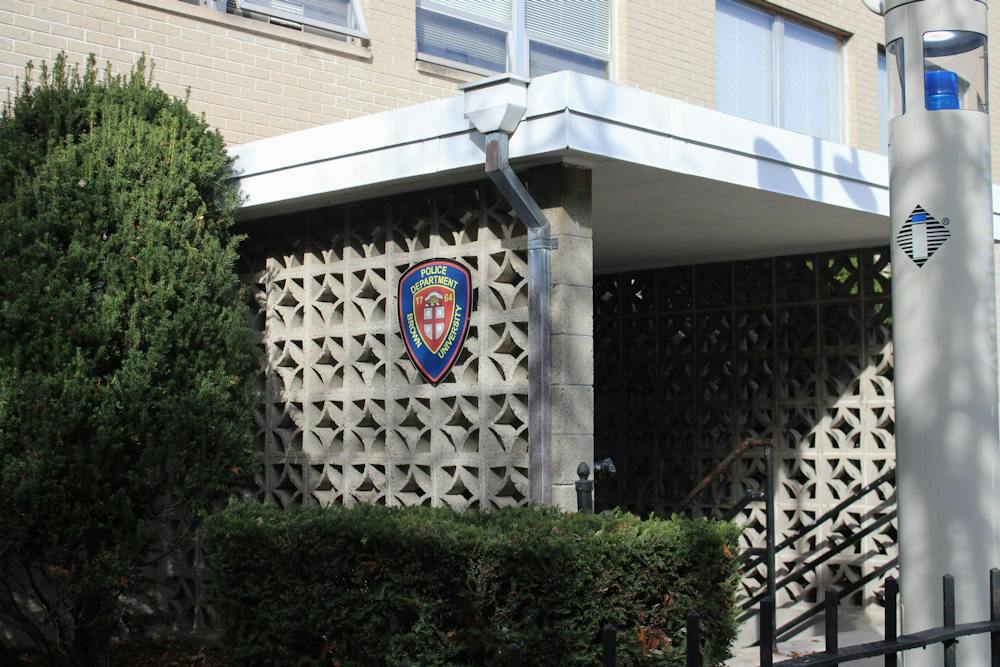
Almost a year after the Dec. 13 mass shooting led Brown to heighten its security posture, University officials have scaled back Brown’s use of external security guards, and the Providence Police Department has decreased its campus presence.
The development comes as administrators focus initiatives on providing support to campus, and as the Trump administration reviews Brown’s security practices.
Following the December shooting, University officials deployed additional guards from two companies — Allied Universal and USENTRA Security Services — to campus spaces including dining halls, the Main Green and Page-Robinson Hall.
“Our priority was providing maximum visible presence to support community reassurance,” Brown Police Chief Hugh Clements said in an interview with The Herald. “It served a specific purpose during that critical time.”
But now, rather than roaming, the Allied Universal and USENTRA Security Services security guards will remain at specific posts. PPD officers will also remain stationed in targeted locations, but with a smaller presence, Clements wrote in a message to The Herald.
Clements declined to comment on the breakdown of staffing numbers, citing security concerns.
“This recent shift was a planned data-driven transition from that acute emergency surge staffing to a sustainable long-term posture,” Clements said, describing the changes as “right-sizing” the University’s deployment of contracted guards.
“We try to rely on our Brown DPS to interact and engage with our campus community,” he said. “They are best served to deal with the campus community.”
“And I know from all the work I’ve done, security is not static. It must be dynamic and responsive to evolving and current assessments,” he added.
Providence chief public information officer Kristy dosReis confirmed in an email to The Herald that the city’s police force has taken on a smaller presence on Brown’s campus.
“PPD continues to patrol the area and remains available to assist Brown when requested,” dosReis wrote. “Our approach is rooted in partnership, and we will continue to work with Brown.”
In the days immediately after the shooting, Clements was appointed interim police chief and vice president for public safety and emergency management. He replaced Rodney Chatman, who had drawn immense scrutiny from his own officers for allegedly contributing to a toxic work environment.
Chatman departed from the University in April as part of a settlement agreement, The Herald previously reported. Deputy Police Chief John Vinson, who was alleged to have perpetrated the toxic environment, left Brown in the same month, according to documents obtained by The Herald.
In December 2025, DPS faced 15 officer vacancies, a figure that decreased to 12 in March, The Herald previously reported. Clements said it has remained roughly the same since then.
“We’ve lost some and added some, but it takes — rightfully so — a long time to onboard a police officer,” he said.
Placing external guards in specific buildings instead of on walking patrol was strategic, Clements said. “As we move forward, we get a better public safety product when we have directed patrols.”
When asked about reports of external guards using cell phones while on duty, Clements said that it “played into our decision making.”
“I just want to reassure the campus community that our commitment in keeping the campus safe hasn’t changed, but how we deliver it continuously is always evolving,” he added. “It’s not measured by the shared numbers of security standing on the corner, but by the quality, the readiness and the integration.”
Representatives for Allied Universal and USENTRA did not immediately reply to The Herald’s requests for comment.

James Libresco is a senior staff writer covering staff & student labor. He is a sophomore from Alexandria, Va. studying political science and contemplative studies. In his free time, he can be found playing basketball, meditating, or losing in Among Us.


