
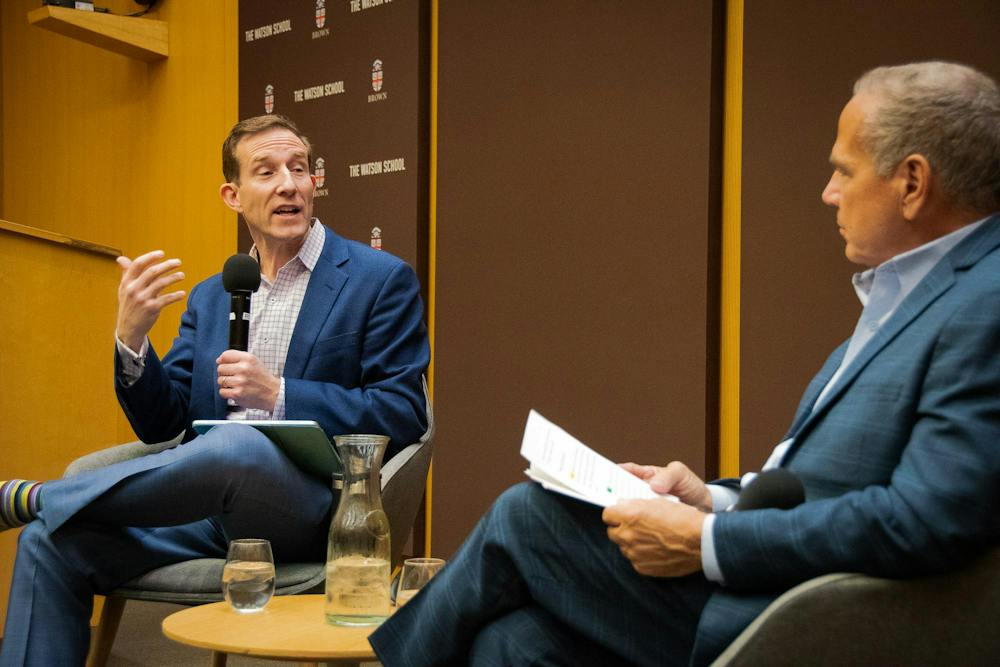
On Monday, Dean of the Watson School of International and Public Affairs John Friedman highlighted the school’s new policy education initiatives and discussed future priorities at a talk commemorating a year since the school's launch.
At the talk, which was hosted by the Brown Club of Rhode Island, Friedman described the shift as “taking the core strengths of the Watson Institute and really expanding on that as we go forward.” The Watson Institute transitioned to the Watson School of International and Public Affairs in July 2025 after about four decades at the University.
In an interview with The Herald after the event, Friedman said that defining what it meant to be “the policy school at Brown” and distinguishing it from similar schools at peer institutions was the school’s “biggest challenge” in the past year.
According to Friedman, the Watson School intends to double the number of its faculty within the next five years, in large part “through hiring with new departments.”
The Watson School will also be jointly hiring faculty with the School of Public Health this year, Friedman said. The school will also hire postdoctoral fellows with the Computer Science and Cognitive and Psychological Sciences departments.
“Five years from now, I want to see a Watson School that’s bigger, but I’d say the ‘bigger’ part isn’t the core thing,” Friedman said. “I want to see a school that’s more deeply embedded with connections to more parts of the university.”
Friedman stated that one of his priorities since the launch of the school has been to encourage local engagement.
He pointed to the spring launch of the Workforce Development Policy Lab, a program that analyzes the efficacy of workforce development and career-focused higher education initiatives in a long-term context. According to Friedman, the school has partnered with the state government, the Rhode Island Foundation and other local organizations for this program. The ultimate goal of the lab’s research is to determine how to make these initiatives “more effective in creating upward mobility for Rhode Islanders.”
In his interview, Friedman also emphasized the Watson School’s focus on providing experiential learning opportunities to students. He noted in particular the Policy in Action Project in the Master of Public Affairs program, where students partner with organizations outside of the University on policy projects.
At the talk, Friedman also highlighted the school’s Military Fellows Program, which welcomes officers to audit graduate courses and participate in research. Last year, the Pentagon cancelled its Professional Military Education affiliation with Brown.
“We’re doing everything we can in order to continue our engagement with military, with veterans,” Friedman said at the talk. The school currently is hosting a visiting military officer from South Korea and a U.S. Coast Guard officer.
Naomi Nesmith MPA’27, told The Herald the talk provided an opportunity “to feel included into the sphere (and) to learn more about what happened in these conversations where we’re typically not there.”
“In my own personal politics, I don’t always see eye to eye with the Dean, but I do respect the fact that he tries to push forward the ideas he thinks best to promote a sense of change,” she stated. “Everything he says and does is very data driven.”
Valeria Gonzalez MPA’27, who is from rural south Texas, shared her appreciation for Friedman’s desire to increase upward social mobility. “It just reaffirmed that there’s just space for everyone within all of these top notch programs,” she said.
“We’re not doing research and teaching just for the sake of an abstract kind of ‘ivory tower,’” Friedman said at the event. “We're doing it because we really want to have an impact in the world.”
Seyla Fernandez is a senior staff writer covering faculty.


