There is a particular kind of girl on the internet who doesn't seem to like purple so much as to have been claimed by the color. I know this because I am, or at least my phone thinks I am, one of them.
As I endeavored down the internet rabbit hole of the so-called “Purple Girl,” it became clear that she exists within a fully developed atmosphere. Edits of purple moons suspended over black water, black cats with violet eyes, long brown wavy hair cascading over a leather jacket, perhaps a flannel, coffee in a mug that you just know has gone cold, purple Converse, images of Euphoria glitter tears, or even better, Maddy, a central Euphoria character who internalizes spectatorship as a form of authorship, in her purple two-piece set from the Season One carnival scene. These reels are almost always soundtracked to a moody hit like Air’s “Playground Love,” or Grimes’ “Oblivion," or the Smashing Pumpkins’ “1979.”
The images themselves have almost nothing to do with one another; purple is the principle that allows them to coexist. The color that turns a collection of otherwise unrelated objects into a single sensibility.
The Purple Girl is a little goth, but not aggressively so; romantic, but too mysterious to be fully realized as such; feminine without the conspicuous labor of femininity; and somehow melancholic without appearing particularly unhappy.
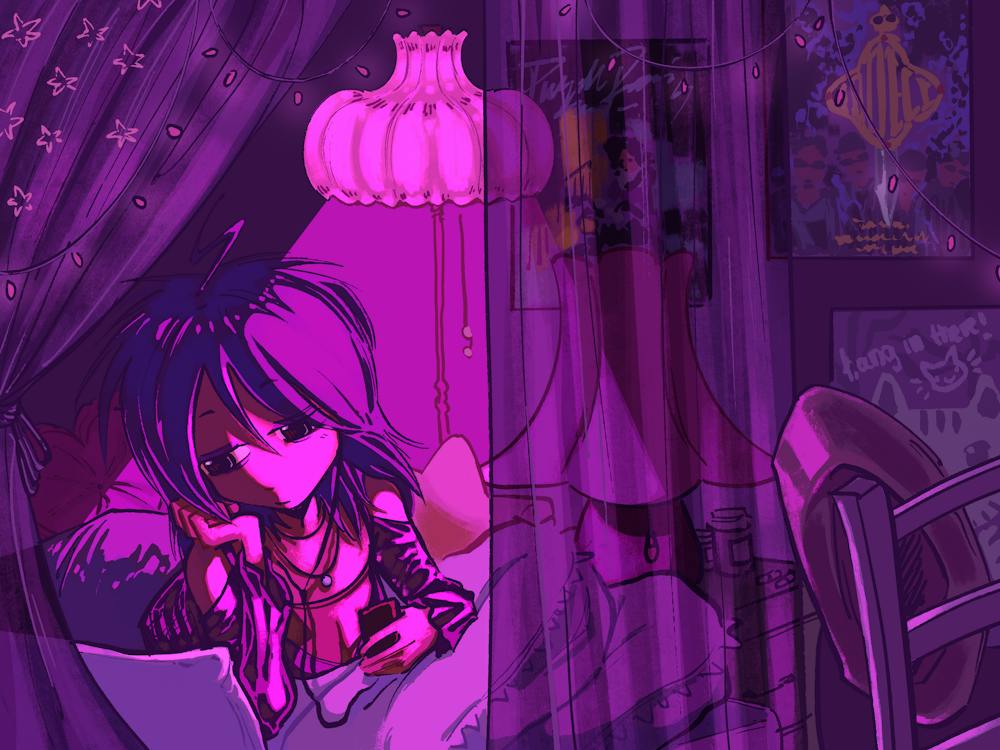
There is also a more maximalist version of her that draws no help from established aesthetics. AI images of a bedroom made entirely purple: purple walls, purple carpet, purple curtains, purple bedding, purple LEDs bleeding across the ceiling, an anime-looking girl with purple hair and purple clothes standing innocently in the middle of the room as though she has not decorated the bedroom but constructed a shrine. Hyperpop plays over the video, and the effect is both absurd and coherent. The color has swallowed the room, and the girl seems to have been swallowed with it.
In either case, purple becomes a persona. What is interesting about these images is not that they accurately describe any particular kind of person, because they obviously do not, but that the color becomes diagnostic. Purple becomes a shorthand for an interior world, a way of suggesting personhood, from what she reads to what kind of sadness she might possess. A preference becomes a personality, and a personality begins to resemble a mythology.
But there is also an underlying notion that the Purple Girl is “unwell.” This is clocked by Reddit users under the thread “People who Love Purple.” With 313 upvotes, u/Spiritual-assist7873 can’t help but notice that people whose favorite color is purple do not merely like it but are “passionate about their purple.” u/Oneiros5321 concurs: “Why does every single person on earth who likes purple make it their entire personality?” The response from one purple partisan, u/PuzzleheadedRoyal559, is characteristically absolute: “??Purple is just a color to you. It’s a religion to us. ✝️✝️.”
But why purple? Why is this particular color so available for the construction of oneself?
The internet did not invent this particular use of purple; it only made it easier to see. Long before liking Instagram reels became a way to signal one's identity, purple was that signifier. Purple, unlike blue to the sky, green to trees and grass, and red to blood and fire, is scarcely found in the natural world. Purple exists, of course, in flowers and fruit and bruises, but it has never occurred as abundantly or as ordinarily as many other colors. For much of history, people worked very hard to produce purple.
The first use of purple was found in prehistoric cave art at Pech Merle Cave in France (c. 35,000–16,000 BCE), where early humans blended manganese and hematite powder to create purplish pigments, using them to paint geometric shapes and animals alike. Cut to 547 CE, purple was the most expensive dye in the world, or at least in ancient Greece. In the city of Tire, now in Lebanon, one of the earliest known forms of purple dye—Tyrian purple—was extracted from sea snails. Famously worth more than its weight in gold during antiquity, its production was incredibly resource- and labor-intensive, requiring approximately 10,000 to 12,000 snails to harvest just one gram of dye.
The result was beautiful enough to justify the trouble. Thus, within Rome, Greece, and the Byzantine Empire, Tyrian purple became the ultimate status symbol. Roman emperors issued laws dictating who could wear it, and under some rulers, any unauthorized citizen caught wearing or trading the color faced asset seizure or even execution.
Purple did not simply signify power, but also helped create the appearance of it. To see purple was to see scarcity, and therefore someone who had access to what almost everyone else did not. The color was evidence of a particular kind of life.
For centuries, purple’s power depended on its rarity. Then, in 1856, English chemist William Henry Perkin accidentally discovered mauveine, the first commercially successful synthetic purple dye, while attempting to synthesize quinine, a treatment for malaria. So now, purple could be sold in shops: dresses, nail polish, eyeshadow, iPhone cases! You name it. The color moved into the private lives of people who had never possessed a throne or expected to.
One might have expected the democratization of the color to destroy its mystique; instead, the terms of the relationship changed. When purple could no longer distinguish the powerful from everyone else, it became available for common people to distinguish themselves from each other.
Purple's meaning was no longer imposed upon the wearer by a court or a law, but could be chosen; once a color can be chosen, it can serve as a form of self-definition. This is perhaps the strange continuity of purple’s history: It has rarely had one fixed meaning, but has repeatedly been useful to people who wanted to make a particular identity visible.
Only within the last century has purple been the visual language of, just to name a few, the women’s suffrage movement, the psychedelic anthem of Jimi Hendrix’s Purple Haze, and a lens to identify beauty (and, with it, a selfhood) in Alice Walker’s The Color Purple, before becoming, in Prince's Purple Rain, an entire world and spectacle that made the color inseparable from the man who created it.
I can't help but hand it to Olivia Rodrigo’s latest ballad “purple,” in which she sings that red and blue (she and a boy, I presume) collide until neither can be picked out of the mix. It is a love song, but it is also almost by accident. People are what happens when two things stop being separate. Maybe that is why purple effortlessly lends itself to obsession: to become obsessed with something is to stop merely seeing it and begin building one’s world around it, letting it arrange everything else. The moon, the cat, the glitter tear didn't belong together until purple gave them a reason to. And the self works just the same, a pile of preferences that, given something to get together around, begins to resemble a person. It's worth remembering what purple costs, that in ancient times the color was an inheritance; it was chosen, it was proof they had been chosen.
The Purple Girl reverses every term of that arrangement, purple arriving endlessly. Yet, she spends it the way emperors did: as evidence. What is scarce now is the feeling of being someone in particular, and purple, cheap as it has become, still promises to supply it.
Last Halloween, I wore Maddy's purple two-piece set, and frankly, that was the hottest I've ever felt, and it wasn't just because I was hidden behind a costume. Nobody is born in purple anymore, but made into the way purple itself was made, with a great deal of effort, out of things that were never purple to begin with, until the result is so vivid it looks like who you were all along.


