
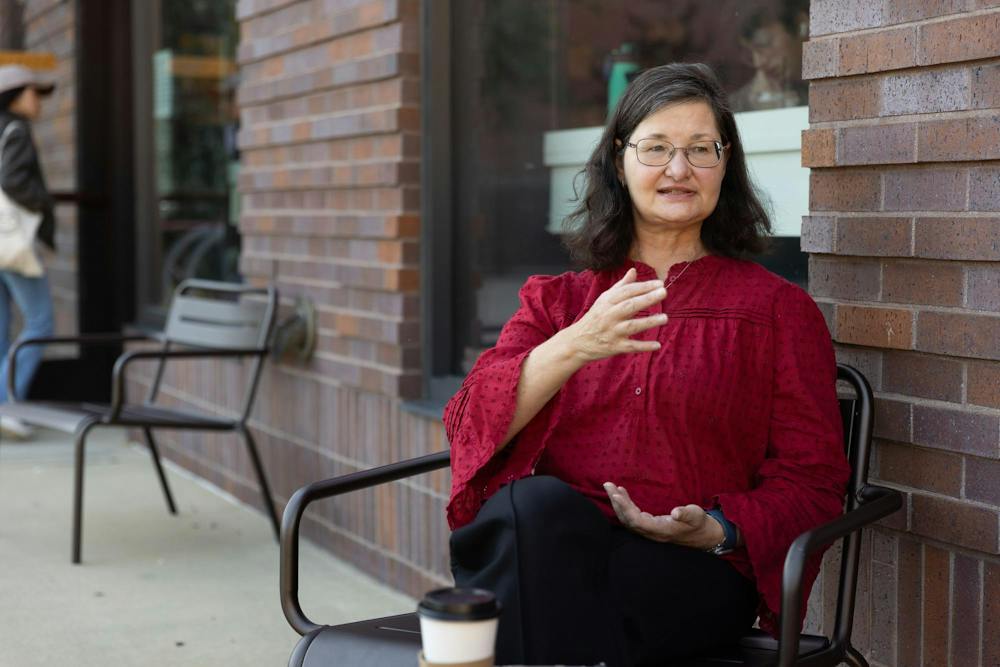
For 20 years, Meredith Alger has worked as a speech and language pathologist in the Providence Public School District. While SLP staffing issues have existed for a while, Alger said that “there’s been a significant, drastic shortage in the last probably 10 years.”
Currently, Alger’s caseload sits at 78 students — 18 more than the contract-negotiated cap. In July, she and other SLPs sat down with the district to come up with a solution to the shortage, but according to Alger, “they said they weren’t going to do any of the things that we requested.” The SLPs felt the logical next step was speaking out at a recent school board meeting.
“SLPs are here tonight because we are concerned that the rights of our students who receive speech and language services are at risk,” Lauri Chung, who has been an SLP in Providence for 20 years, said in her testimony at a Sept. 23 school board meeting. “Our district currently has a significant SLP shortage.”
“PPSD currently has 16 Speech-Language Pathologist vacancies,” PPSD spokesperson Alex Torres-Perez wrote in a statement to The Herald. “Given the specialized nature of these roles, we are implementing targeted, ongoing recruitment efforts to expand the candidate pool, accelerate placement and strengthen long-term recruitment pipelines.”
Currently, the SLPs are asking for overage pay if they are assigned more cases than the 60 student maximum. They are also seeking longer-term solutions to attract talent to the district and support current employees.
“If our building has 85 kids that we need to serve, then we just have to do it,” Jessica Pollard, an SLP who has worked in the PPSD for seven years, wrote in a message to The Herald. “Our job is a lot more than just sitting down with students. There’s a lot of meetings, paperwork, planning and Medicaid billing involved.”
“With a larger caseload you have to see larger groups in order to make the mandate work,” Pollard explained. “I find any group over four or five can be challenging because each student has different goals. Some kids really do need to be seen in groups of two or three.”
According to the American Speech-Language-Hearing Association, in 2024, speech pathologists nationwide had a median monthly caseload of 50 students. In New England, the average caseload was 40.
SLPs are asking for the reinstatement of paid professional development and more serious recruitment strategies to ensure vacancies are filled with urgency. Some have mentioned that an incentive program, such as one where SLPs get their graduate degrees paid for in exchange for working a certain number of years, could help attract talent to the PPSD.
Torres-Perez noted that the PPSD is starting to explore partnerships with “college and university preparation programs to support future SLP recruitment.”
“Our immediate priorities are to maintain targeted sourcing activity, prioritize qualified SLP candidates for school-level review, leverage upcoming recruitment events and strengthen relationships with university preparation programs,” Torres Perez wrote. “We will continue monitoring candidate pipeline growth and hiring outcomes to assess progress toward filling the district's 16 current SLP vacancies.”
One current solution to the SLP shortage has been to employ virtual speech pathologists from out of state, according to Judith Dixon, who has been a SLP for nine years in Providence. But she said at the Sept. 23 meeting that “virtual services are not interchangeable with an SLP who is physically present — particularly for our youngest students.”
The SLPs have also suggested a $5,500 bonus for pathologists that are nationally certified. Currently, PPSD teachers who have a national board certification earn a $5,500 bonus. SLPs have also advocated for therapy and evaluation materials that reflect caseload needs.
Pollard, who currently works with a caseload of 55 middle school-aged adolescents, noted that the materials she needs differ from other SLPs. “Right now we have a very limited array of testing materials and I have absolutely no materials that are given to me,” she added. “I make my own or buy my own.”
This summer marked the shift of SLP advocacy, according to Alger, with a new president of the Providence Teachers Union. Alger noted that there are almost 2,000 teachers in the PTU, compared to only 38 SLPs when she started — which has decreased to just 25 today. She added that the typical response from the Union previously has been “we’re not really worried about you guys. There’s only 38 of you.”
“When the SLPs reached out with their concerns, it was easy to see the patterns in other areas of special education and some of our hard-to-fill positions.” Lindsay Paiva, president of the PTU, wrote in a statement to The Herald. “The shortages and vacancies in any position in our district can be directly linked to working conditions, and we have a shared responsibility to move in solidarity with one another because an affront to one is an affront to all.”
Pollard said that, in the ASHA code of ethics, speech pathologists need to advocate for the needs of students who are most vulnerable whenever possible.
“I see speaking out to the board part of this ethical obligation to advocate for those who need it,” she said.

Amber Marcus-Blank is a metro editor covering youth & education. She is a senior from outside of Boston studying Political Science and Public Health on the pre-law track. She is interested in working in politics and journalism in the future and enjoys playing soccer and making playlists in her free time.


