
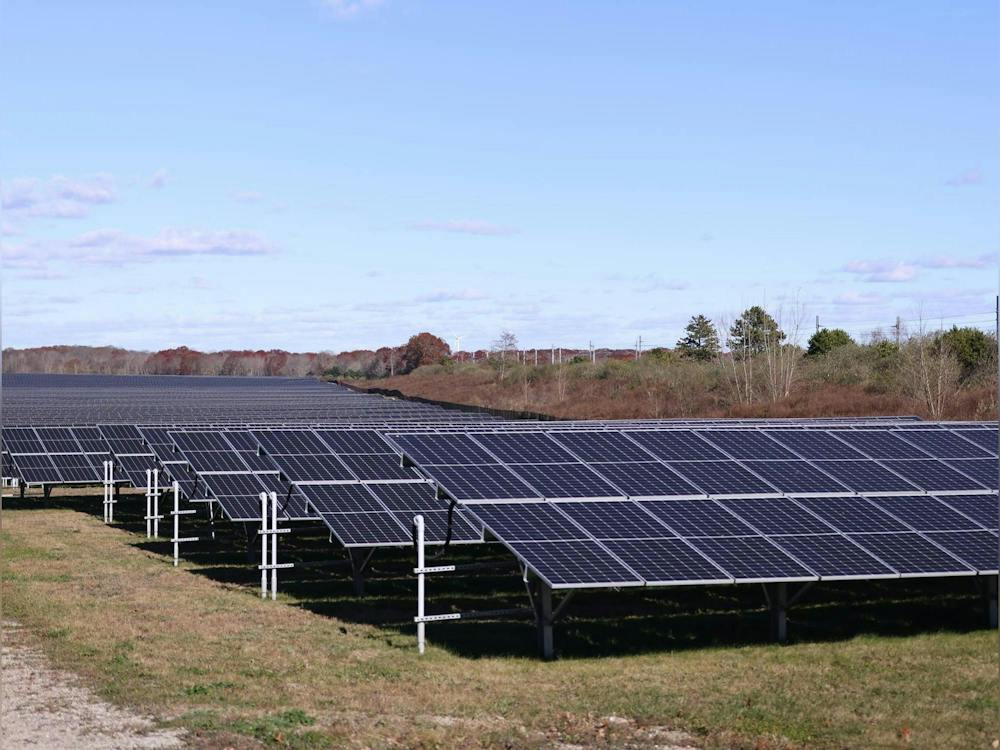
On Sept. 18, a Rhode Island federal judge ruled that the Environmental Protection Agency must distribute $7 billion in “Solar for All” funds that were canceled by the Trump administration last year.
Solar for All was a grant program launched in 2023 that allocated Rhode Island $49.3 million to expand solar power access for low-income communities. But in July 2025, President Trump cut the program as part of his “One Big Beautiful Bill” Act.
That October, the Rhode Island AFL-CIO, a labor advocacy group, and the Rhode Island Center for Justice, a nonprofit law center, joined other groups across the country to sue the EPA.
U.S. Judge Mary McElroy of the U.S. District Court for Rhode Island, who was appointed by Trump in 2019, handed the victory to the R.I. plaintiffs just under two weeks ago, and on Sept. 22, a federal judge in Texas arrived at a similar ruling.
“Congress’s clear intent was that (the) EPA continue to administer the already obligated (Solar for All) grants,” McElroy wrote. “The termination decision was therefore contrary to law and in excess of its statutory authority.”
Aislinn Hanley, program director at Climate Jobs Rhode Island, said a major aim of Solar for All was the concept of “community solar.” Solar for All “would have helped us both reduce emissions, and also build out our local energy,” which would ease energy costs, according to Hanley.
Solar power is currently “a mid-upper income resource,” said Jeff Migneault, executive director of Climate Action Rhode Island. Solar panel projects typically have “high upfront costs, even though they save money over time,” he added.
Hanley said that Solar for All would have created well-paying green jobs, providing a boost to the economy that would have benefited low-income Rhode Islanders.
Additionally, the solar rollout would have helped Rhode Island meet its 2021 Act on Climate decarbonization goals, Migneault said. He added that the state is “already not on track” to meet those targets.
Hanley described the delays with the Solar for All funding as “incredibly disruptive,” as they have taken away taxpayer-funded “affordable power the people deserve” during a time when energy prices have been steadily rising.
Over the summer, Gov. Dan McKee declared a state of emergency over energy affordability. As a result, the Rhode Island Public Utilities Commission approved a bill last Thursday providing $28 million in direct relief to R.I. residents to address high winter energy prices.
To Hanley, the EPA ruling is “a step in the right direction,” but it is too soon to declare victory.
The agency is currently “reviewing the decision and considering options for appeal,” an EPA spokesperson wrote in an email to The Herald.
“It is unfortunate for our workers and residents who are the ones being caught up in this process,” Hanley said. “Hopefully, we’ll get to see that money and be able to get the work going.”
Robert Beadle, a spokesperson for the R.I. Office of Energy Resources — the department that would have oversight over the distribution of Solar for All funds — wrote to The Herald that the OER “is aware of the recent court decision and is monitoring next steps.”
“We’ll keep fighting,” said Patrick Crowley, president of the Rhode Island AFL-CIO. “The ball is in the government’s court. If they want to continue to pursue this, we’ll see them in front of a judge.”
Talia Katz is a senior staff writer covering city hall and crime.


