
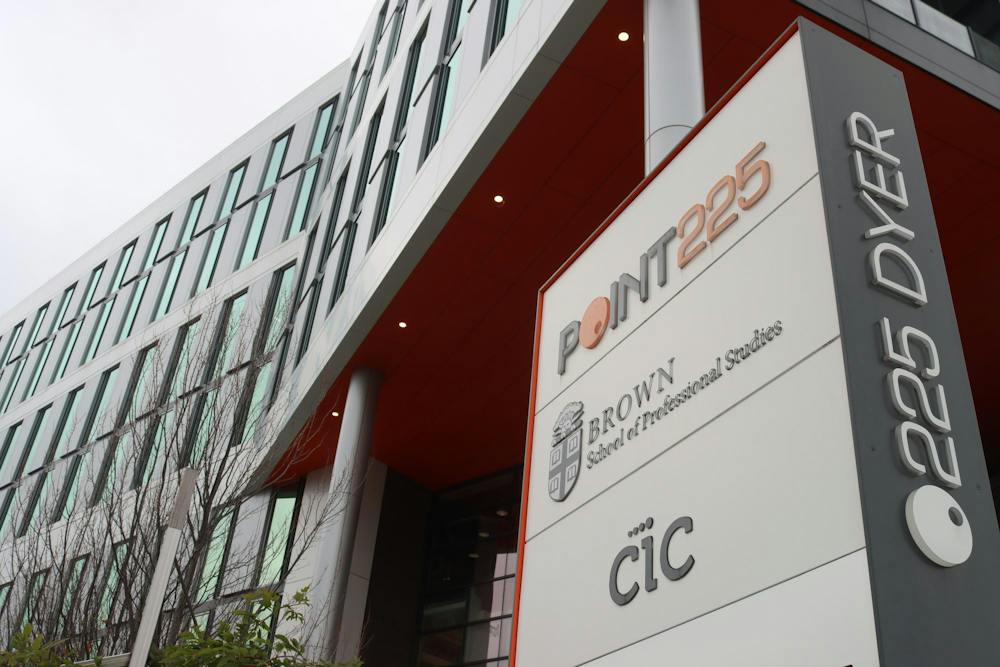
At the Brown Invents Startup Challenge, a pitch competition during last month’s Rhode Island Startup Week, seven startups showcased their product proposals and competed for a $10,000 cash prize. While the majority were spearheaded by Brown professors, two of the ventures were founded by students and recent alums.
Naiad Technologies and Red Maple LifeSciences both seek to bring innovative science to the market.
Malia Chavinson ’27 founded Naiad Technologies with the aim of developing a buoy that “minimizes economic losses for lakeside communities by removing pollutants to mitigate toxic algae blooms and protect ecosystems,” she wrote in a statement to The Herald.
The inspiration for Naiad’s product, Cyrene, draws on Chavinson’s youth in California, where she witnessed the impacts of climate change firsthand.
“Starting Naiad Technologies is my way to help establish and fund climate adaptation solutions for communities, like mine, most at risk for the consequences of climate change,” Chavinson wrote.
Red Maple LifeSciences is focused on developing wound-care technology that releases treatment when triggered by specific bacteria. The company’s interim Chief Scientific Officer, Professor of Engineering Anita Shukla, believes that Red Maple’s technology is capable of mitigating the growing global problem of antimicrobial resistance to existing medicine.
“That, to me, is such a huge part of the benefit,” she said. “For humanity, it is a big, big, big positive,” Shukla said.
Alec McCall PhD’26, the CEO of Red Maple, got involved in researching bacterial-responsive wound dressing as a Ph.D student in Shukla’s lab. “That's a lot of the foundational work that we are taking as Red Maple,” McCall said.
Shukla said that McCall joined the lab at the same time she felt the technology was ready to be introduced to the market.
McCall met Red Maple’s Chief Operations Officer William Ash ScM’26 in an applied differential equations course, where they both bonded over their interest in building a startup. After serving together as co-chairs of the corporate development group on the Biomedical Engineering Board, a graduate student organization aimed to increase student participation in program decision making, they kept in contact.
When McCall decided to go to the National Science Foundation Innovation Corps Program, an entrepreneurial training program, he asked Ash to join him. Now, the two are collaborating at Red Maple LifeSciences.
Red Maple is currently working to secure funding, McCall said. So far, that journey has required meeting with clinicians, patients and other stakeholders — including other wound care companies and regulatory consultants.
For Chavinson at Naiad, the process of launching has looked like a lot of “problem and customer research” and adapting her product to meet the changing needs of consumers.
“I wish I could provide a checklist of skills and milestones that you need to hit,” wrote Chavinson, noting that “every venture is so different on account of their specialties and services.”
Getting the startup off the ground has required thoroughly understanding the research behind the product, their competitors and their potential customer base, Chavinson noted, adding that this process involved finding a solution that is actually needed by their customer base.
Despite the challenges, both the teams at Naiad and Red Maple say the journey has been rewarding.
Ash said he has enjoyed “getting closer with clinicians and building relationships with them.”
For Chavinson, the most exciting part of developing her company has been “talking with people who are so excited about how Cyrene can help solve their problems.”
At its core, building and scaling a startup “just takes intentional iteration,” Ash said. “You need to have confidence in what you're building, but not overconfidence in the structure around it.”
Lucia Santiago is a senior staff writer covering undergraduate student life.


