
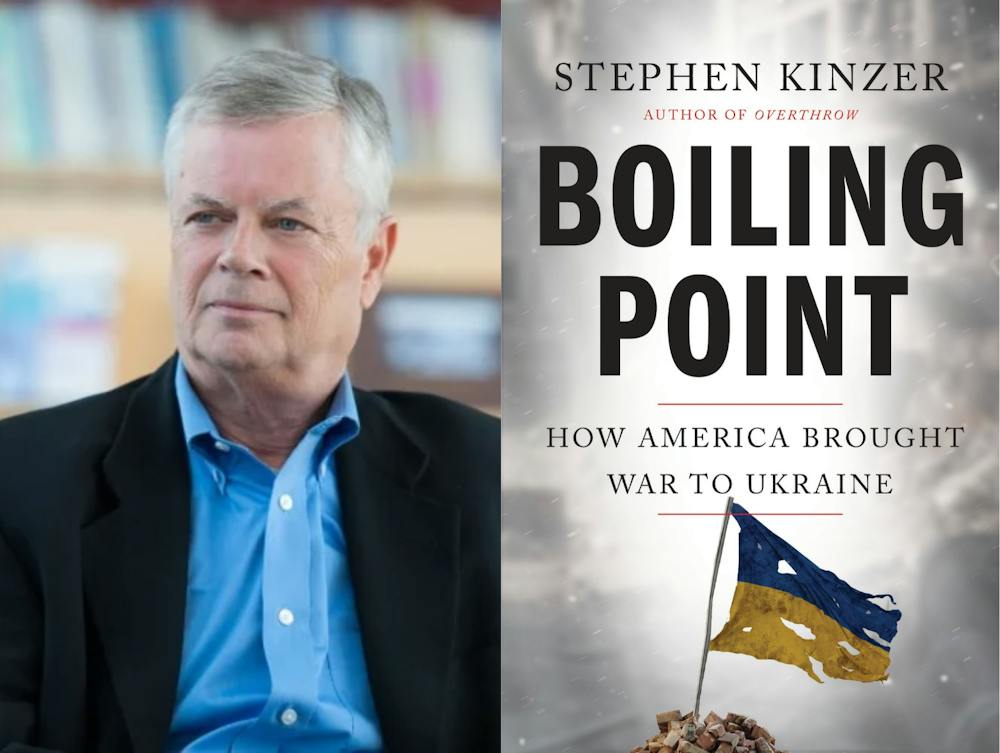
On Tuesday, Stephen Kinzer, a senior fellow in international and public affairs, released his new book “Boiling Point: How America Brought War to Ukraine,” which argues that the Russian invasion of Ukraine was not unprovoked, but catalyzed by long-standing conflict between the United States and Russia.
Kinzer described his motivation for writing the book as “very simple.”
“I just heard the word unprovoked too many times,” Kinzer said in an interview with The Herald. “The Russian invasion of Ukraine might have been wrong. It was certainly aggressive. You can call it evil or horrible or whatever you think of it, but it was definitely not unprovoked.”
“We created this narrative that it was just one evil figure — Putin — who created this war. In fact, as my book points out, (the United States) worked for 75 years to provoke Russia,” Kinzer said.
Before his career as an academic and author, Kinzer worked as a New York Times correspondent covering the Contra War in Nicaragua. While reporting, he realized that the war “had nothing to do with Nicaragua.” Instead, Nicaragua just had the “bad luck” be the location of outsiders’ conflict.
“I see the same thing in Ukraine. This war has nothing to do with Ukraine. It’s all about the U.S.-Russia conflict,” Kinzer said. “We have been trying for 75 years to use Ukraine as a battering ram against Russia, and my book is the story of all the pieces of that campaign.”
In “Boiling Point,” Kinzer traces the origins of U.S. intervention in Ukraine back to the late 1940s, when the CIA sent soldiers into Ukraine “in the hope of setting off a rebellion against Moscow.”
According to Kinzer, the CIA started a publishing house in the 1950s to create propaganda for Ukrainian nationalism and promote anti-Russian feelings. By the end of World War II, the United States “set out to establish an espionage network in the Soviet Union.”
“Boiling Point” also looks at how the United States recruited former Nazis with anti-Soviet sentiments to that espionage network. Kinzer specifically mentioned Reinhard Gehlen, the chief of Adolf Hitler’s intelligence service for the Eastern Front, who defected to the United States and became a key figure in the CIA’s Ukraine project by turning over the Nazis’ anti-Soviet network.
This covert spying operation continued through Ukraine’s independence in 1991, Kinzer said.
According to Kinzer, the CIA effort was first directed at “producing a government in Ukraine that would be pro-American, pro-NATO and anti-Russia,” despite the fact that public opinion polls in the years after Ukrainian independence showed that a slight majority of the population did not want to join NATO. Ukraine is still not a member of the alliance, though it has pursued membership in recent years.
Kinzer said that the United States “pushed relentlessly to get a government into power in Ukraine that would support the NATO anti-Russia project that finally succeeded with the uprising in 2014.”
The White House did not immediately respond to The Herald’s request for comment.
After the CIA’s operations became increasingly publicized in the 1970s, the United States switched from covert to overt intervention through the creation of the National Endowment for Democracy, which “is empowered to go out and set up organizations, committees, groups inside whatever country it is that we want to subvert,” Kinzer said. “Ukraine is one of the first examples of a kind of postmodern form of intervention.”
Kinzer said once the United States had a favorable government in power in Ukraine, Americans “became very excited about the possibility of confrontation” with Russia, particularly because it would not involve the loss of U.S. troops.
Regardless of whether Russia accepted Ukraine joining NATO or chose to invade, those involved in U.S. intervention believed it would be good for the United States “because it allows us to portray Russia as the evil figure,” Kinzer said.
Mark Kramer, director of the Cold War Studies Project at Harvard, criticized Kinzer’s argument. “The notion that the United States should somehow be blamed for (Russia’s invasion of Ukraine) strikes me as really contemptible.”
He added that Kinzer’s book portrays a “fanciful argument” that “the West was really steering Ukraine into NATO, and that provoked Russia again. It just doesn’t hold up to reality.”
Kramer said that a series of events, including Russia’s attempt to rig Ukrainian elections in 2004 and a low-level war instigated by Russia following its 2014 occupation and annexation of Crimea, caused the invasion of Ukraine.
“It had nothing to do with the United States. It really had to do with Russia’s disaffection with what was going on in Ukraine, which was that Ukraine was moving closer to a democracy, true democracy,” Kramer said.
The Russian and Ukrainian governments did not immediately respond to The Herald’s request for comment.
In a follow-up email to The Herald, Kinzer asserted that “If Joe Biden had simply pronounced five words — ‘Ukraine will not join NATO’ — this war would probably never have happened.”
“Expecting Russia to accept a hostile military alliance in Ukraine is equivalent to expecting the U.S. to accept Mexico joining an alliance with China, and allowing the Chinese to build a naval base in Veracruz — 800 miles from Texas,” he said. “We would never tolerate that, nor should we.”
The Office of Joe and Jill Biden did not immediately respond to The Herald’s request for comment.
Cameron Zytkewicz Ray ’26 GS, who helped Kinzer with “Boiling Point,” explained that the process of researching helped her “further understand the historical context behind contemporary foreign policy issues, and it was kind of a reminder that international relations are rarely as straightforward as they may initially appear.”
Kinzer said that his books are targeted at an audience of “ordinary interested readers.”
“I like my books to be page-turners, so I always have an eye for a good story, for a good sentence, for a good person, for a good episode,” he added.
According to Kinzer, the process of creating “Boiling Point” was also aided by many undergraduate students.
Leah Freedman ’27 took IAPA 1203: “History of American Intervention” with Kinzer in fall 2024. She explained that at the time, Kinzer was looking for research assistants to help him gather “any historical documents for his writing process.”
The documents informing Kinzer’s research included declassified CIA documents.
Kerem Koyluoglu ’27 worked as a photo research assistant for Kinzer. “Whatever photos he wanted, I had to go hunt down where they were from,” Koyluoglu said. He also worked to get licenses for the photos so “Boiling Point” would not face any copyright issues.
“I don’t even agree with the book. I don’t think that it’s true what he’s saying that American NATO expansion was what cornered Russians invading Ukraine. I don’t actually believe that as an argument,” Koyluoglu said. “I think that 99% of the time, Professor Kinzer has great takes, but on this one I actually don’t agree with him.”
Kinzer wrote in an email to The Herald that he expects criticism of his books because “they tend to challenge established narratives.”
“I think it’s important for people who are interested in the world not to accept the mantras and the government-fabricated narratives that explain what happens in the world beyond them,” he said. “That’s exactly what my book is trying to do.”

Alice Xie is a section editor for Science and Research from Los Angeles, California. She studies Applied Mathematics and Biology, and enjoys reading gut wrenching literature in her free time.


