
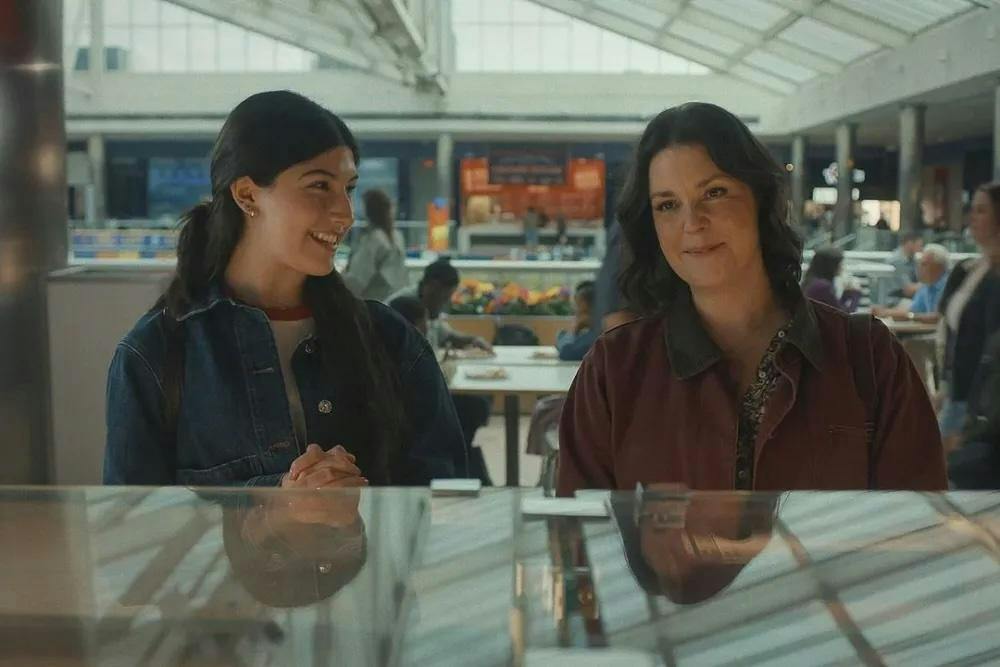
Coming-of-age film “Don’t Say Good Luck,” released Aug. 14 on Netflix, poses an impossible question: What are you supposed to do as a teenager knowing that your mother may not live to see who you become? In the film, Sophie (Sunny Sandler) is forced to find an answer.
Sophie’s life is split between two merging worlds. At home, she is forced to watch her mother (Melanie Lynskey) battle a cancer relapse while her family becomes desperate for normalcy. At school, Sophie is an aspiring actress who earns the lead role in her high school musical. As she continues her life as a typical high school student, her mother’s condition worsens and lingers in the background. The film follows Sophie’s life as she struggles to keep these worlds separate.
“Don’t Say Good Luck” refuses to let this impending, painful loss define Sophie’s adolescence. Instead, the film lets grief sit alongside the ordinary difficulties of growing up.
Theater turns out to be a great outlet for Sophie in the midst of the uncertainty surrounding her mother. While she cannot control what happens at home, she is able to lose herself in the character that she plays, allowing the stage to become a space where she can process emotions she otherwise struggles to express. As Sophie puts it, “Music can make you feel things that are bigger than just talking.”
While many films overdramatize high school theater, “Don’t Say Good Luck” stays levelheaded. The portrayals of awkward theater kids effectively convey the camp without overplaying the stereotype.
Sandler’s stellar performance is perhaps the film’s greatest surprise. As the daughter of Adam Sandler, her name inevitably comes with immense expectations. Yet, her portrayal of Sophie stands on its own. What makes her performance so strong is her restraint. Sophie rarely outwardly carries the pain of her mother’s illness. Her grief, instead, sits below her conversations, relationships and performances, slightly emerging and then going into hiding once again. Sandler seems to understand that Sophie is not a character that needs to constantly cry or talk about her mother to communicate her pain.
At times, this focus on Sophie tends to leave some of the supporting characters underdeveloped. Their individual relationships are briefly mentioned and then pushed aside once the story returns to Sophie. While the fact that the other plotlines are neglected brings a sense of incompleteness to the film, the primary plot is strong, making these omissions more forgivable.
Ultimately, “Don’t Say Good Luck” finds hope in a place where there seems to be very little. Even as her family struggles, Sophie can still perform, fall for someone, fight with her friends and continue growing up.
This film never tries to make death less devastating. Instead, it has a way of reminding viewers of the truth: Life continues even while knowing that a part of it may very well disappear.
Timothy Ro is a senior staff writer covering arts and culture.


