
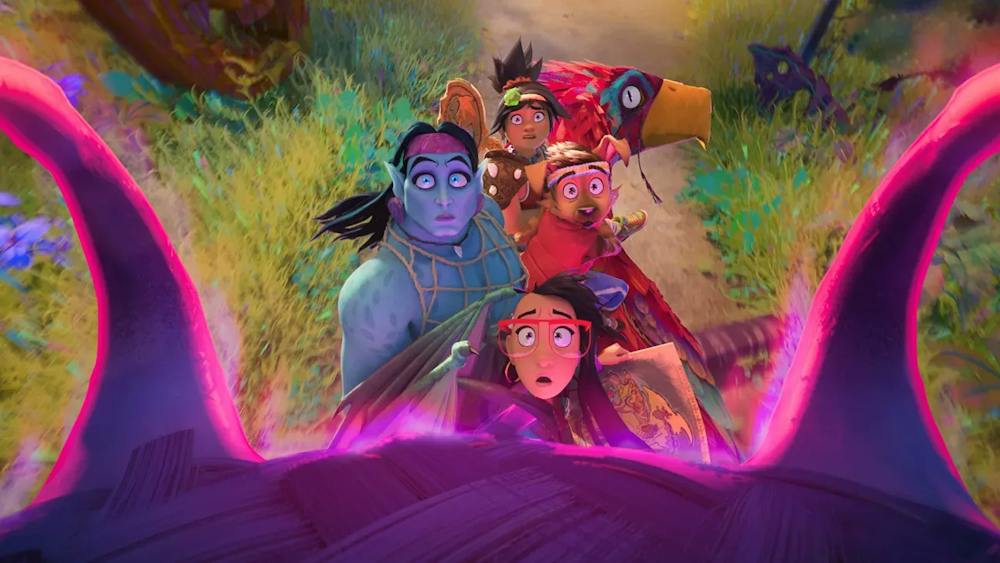
“Forgotten Island,” directed by Januel Mercado and Joel Crawford, is an incredible spectacle of color and sound. The new DreamWorks film, which will be released in theaters on Sept. 25, follows childhood best friends Raissa (Liza Soberano) and Jo (H.E.R) as they are transported to the mythical island of Nakali — a place filled with creatures from Philippine mythology. The Ivy Film Festival held an early screening of the film at the Avon on Sept. 21.
Set in the Philippines in the 1990s, the movie begins with a gloriously analog montage of the friends’ childhood memories: karaoke, talent shows, mixtapes and reruns of “Predator,” from which Raissa and Jo emulate Arnold Schwarzenegger and Carl Weathers’s legendary handshake. Jo’s grandmother, Lola Fatima (Dolly de Leon), tells them about her travels to the magical land of Nakali — which means “counterfeit” or “artificial” in several South Asian languages.
Now adults, Raissa and Jo are preparing for the next stage of their lives. Raissa is off to study at the California Institute of Technology, while Jo, alone following the death of Lola, works at a fast-food restaurant. The night before Raissa’s flight, the two friends are suddenly sucked into a portal that transports them to Nakali.
They awake on the island the following morning with radically changed physical appearances — and no recollection of their night. It becomes a race against the clock to recover their memories from the previous evening and return in time for Raissa’s flight.
Within the first 30-seconds, Mercado and Crawford have brought the film’s energy to high heights, and this excitement is maintained for the rest of the movie. Filled with eccentric characters, overwhelming world-building and a series of over-the-top action sequences, “Forgotten Island” is the epitome of extra. While the overstimulating effects and non-stop drama of the film can be read as a bleak commentary on our degrading attention spans, there is no denying that it is a lot of fun.
Only towards the end of “Forgotten Island” are audiences given the time to contemplate the film’s broader message around friendships and how they shape our memories, identities and sense of belonging. Though friendship is a common theme for a family movie, the film does not feel heavy-handed, nor does it lean too much into cliche.
It is a shame that “Forgotten Island” takes nearly the full hour and 50 minute run time to identify its emotional core. Moments when the characters slow down to have normal human conversations — as opposed to screaming at each other — are few and brief, and even then are filled with slapstick humor that undermine what otherwise could have been promising moments for character development and connection.
Mercado and Crawford seem almost afraid that giving a character too much continuous screen time would bore audiences. For example, the fact that Raissa and Jo’s friendship originated from the question “Do you want to be best friends?” feels lazy and indicative of the directors’ prioritization of action scenes. By refusing to slow down, they lose an opportunity to build stronger, more complex characters.
Jo has the potential to serve as an interesting site for examining the way friend and family relationships intertwine, particularly in periods of grief. When she implies at one point that she doesn’t think anyone would notice if she disappears, it reveals an intense grief beneath her bravado and rambunctiousness.
When the film’s emotional core finally arrives — played out in a gut-wrenching sequence during which Raissa searches for Jo among disintegrating memories — it is among the most resonant animation scenes in recent memory. The scene is comparable, both thematically and emotionally, to when Bing Bong dies in “Inside Out.”
As a spectacle, “Forgotten Island” is an absolute pleasure to watch, and it is ultimately a film that brings a lot of joy. Every aspect has been rendered with great care. The creatures of Philippine myth are complex and extremely entertaining, all brought to life within a stunning landscape and immersive visual style that integrates 2.5D painterly animation — a blend of 2 and 3D styles — with elements of anime and traditional hand-drawn illustration. The result is a film which feels contemporary yet nostalgic, much like the friendships it is celebrating.


