
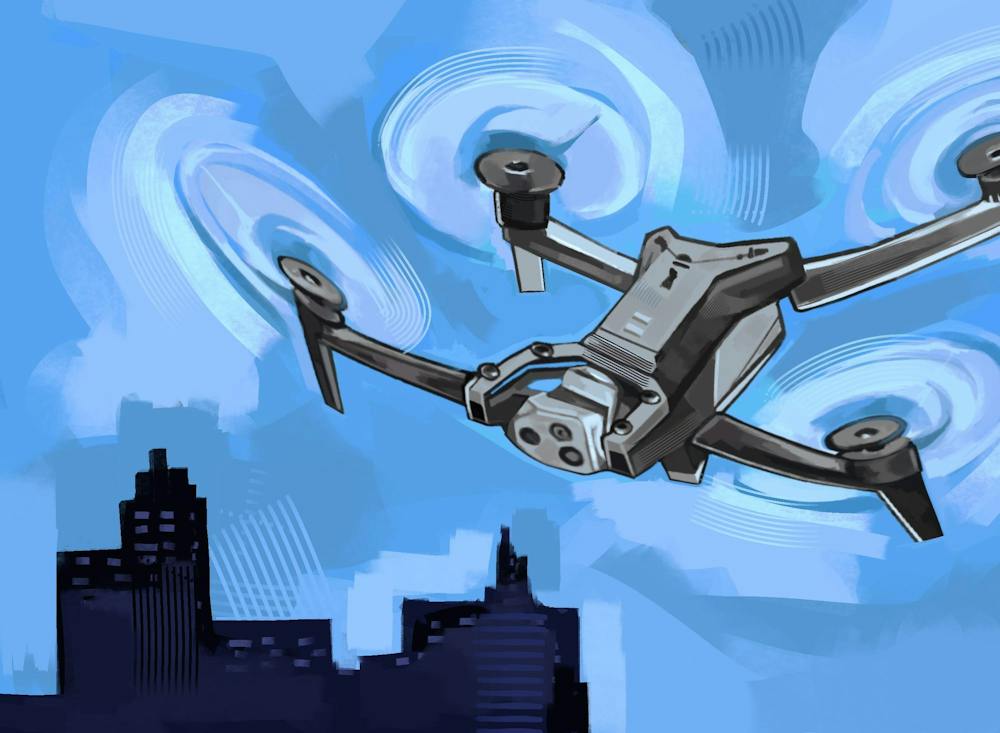
This June, the Providence Police Department gained five new pairs of eyes in the skies. Weighing less than five pounds each and with up to 40 minutes of flying time, these Unmanned Aircraft Systems contain camera and thermal-imaging technology.
The additions are part of the Drone as First Responder program, an initiative that has been gaining popularity across the country this year. In recent months, DFR programs have been deployed in California, Washington and Tennessee.
In Providence, “the DFR program is designed to provide rapid aerial situational awareness to officers responding to an incident,” Kristy dosReis, Providence’s chief public information officer for public safety, wrote in an email to The Herald. “Rather than waiting for officers to arrive and assess a scene, a drone can often arrive within minutes and provide real-time information to personnel on the ground.”
The drones are stationed in rooftop stations at the Providence Public Safety Complex. Trained PPD personnel can operate them remotely from the Real Time Crime Center — a data-sharing public safety hub that has come under scrutiny for its surveillance capabilities.
According to dosReis, DFR deployments are authorized to respond to an array of situations including the search for a missing person, documentation of crime scenes and the pursuit of a suspect fleeing a crime scene. PPD already deployed drones on Sept. 5 to help officers maintain visual contact with an individual suspected of possessing a firearm, and again on Aug. 31 to provide real-time information on a reported pop-up party near Harris Avenue.
Brandon del Pozo — an assistant professor of medicine and of health services, policy and practice who worked as a police officer for 23 years — told The Herald that “there are very few to no downsides” to piloting drone programs, particularly in Providence.
He emphasized the city’s lack of high-rise buildings and the presence of criminal activity as factors conducive to introducing a UAS initiative.
“With a modest investment in drone technologies, you can really improve police services,” del Pozo said.
Meanwhile, the PPD isn’t the only agency in Rhode Island that has incorporated drones into its law enforcement strategies.
Just a short drive away, the Warwick Police Department also operates UASs, according to Major Joel Thomas.
The department’s two “Avata” drones produced by the company DJI “are used during tactical incidents where obtaining visual information before sending an officer into an area can reduce risk,” Thomas wrote in an email to The Herald. The traffic division also uses DJI’s “Mavic” drone to obtain more complete information about serious motor vehicle crashes.
According to Lieutenant Adam Kennett, the UAS Unit of the Rhode Island State Police department currently operates a fleet of about 20 aircraft.
Kennett recounted an incident in August during which a UAS equipped with thermal imaging helped fire personnel locate a distressed individual in a swamp.
But the implementation of drone technology across the state has not come without controversy.
“It’s hard to tell, from our position, the internal workings of a drone as a first responder,” Madalyn McGunagle — the policy associate at the American Civil Liberties Union of Rhode Island — told The Herald. “Is the camera on the entire time the drone is flying? Are they capturing things on the way to go into whatever scene it may be? And then the question is, how long is that (data) kept?”
McGunagle commented that state-level privacy protections are “not catching up with” the development of new technologies including drones, automated license plate reader Flock cameras and more. Currently, there are no statewide policies regulating the usage of UASs by law enforcement.
“Every time a new surveillance technique is introduced, it just erodes our expectation of privacy a bit more,” McGunagle said.
Among other restrictions, the PPD’s policy “specifically prohibits random surveillance and requires UAS deployments to comply with applicable state and federal law and the Fourth Amendment,” dosReis wrote.
She added that personnel are also prohibited from “using a UAS to view or record video or photographs in an area where a person has a reasonable expectation of privacy unless a valid search warrant has been obtained.”
Kennett wrote that no RISP UAS platforms can record audio.
“We understand why the public would have questions about privacy whenever law enforcement adopts technology that has the ability to capture images from the air,” Thomas wrote. The usage of drones “must be connected to a legitimate law-enforcement or public-safety purpose and remains subject to the same constitutional protections and legal requirements that govern other police investigative activity,” he wrote.
“It’s not like there’s a fleet of drones just hovering over Providence right now, just soaking up camera footage of the city,” del Pozo said.
Still, he added that tight regulations are vital to the safe usage of drones by law enforcement. Further technological advancements need to be “carefully developed and regulated,” he said. “You can’t just experiment. You need to be extremely deliberate.”
“The future is coming,” del Pozo said. “We need to be proactive about how we introduce things like this and not just let them stumble on us.”
“Seeing these new introductions of these technologies,” McGunagle emphasized that “each one costs a little bit more to our privacy.”
In the future, she hopes to see statewide policy standardize regulations around drone-captured footage, she told The Herald. She also hopes to see increased public transparency about the program and its operators.
“The goal is not to increase surveillance of Providence residents,” dosReis wrote to The Herald about the DFR program. “The goal is to put information in the hands of responding officers before they arrive or while an incident is unfolding.”

Michelle Bi is a metro editor covering City Hall & Crime and State Politics & Justice. She is a junior from Oak Park, CA and studies English and IAPA. In her free time, you can find her playing guitar, the LA Times crossword or one of her 115 Spotify playlists.


