
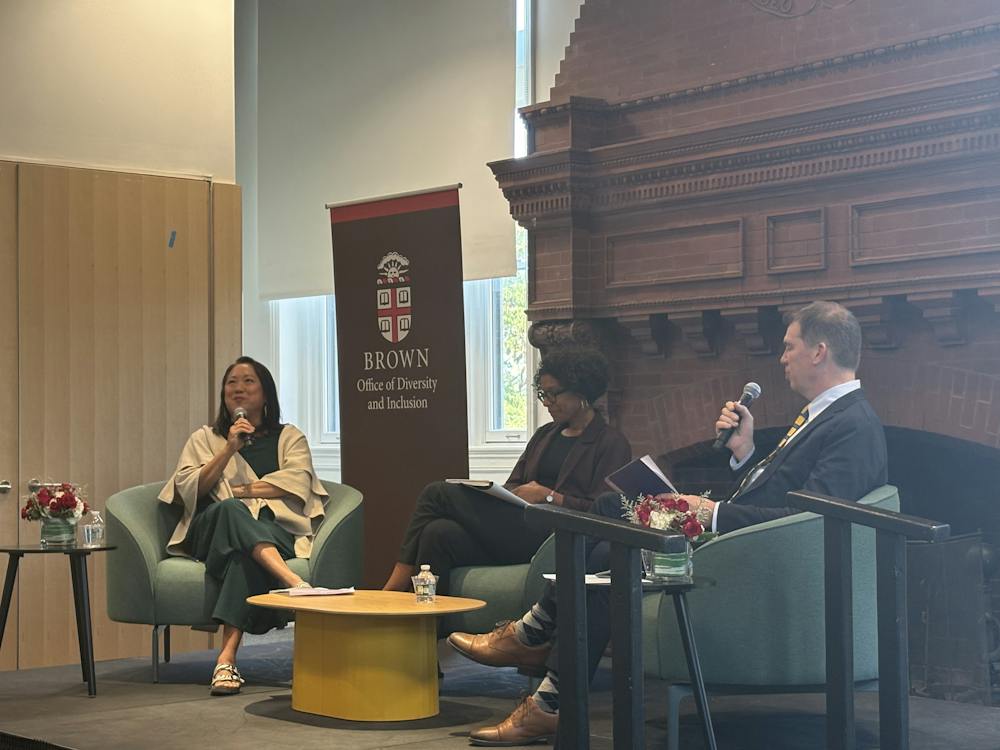
On Wednesday, Brown students, faculty, staff and community members, gathered in Pembroke Hall for the inaugural Slavery and Justice Lecture. The event comes two decades after the release of Brown’s “Report of the Brown University Steering Committee on Slavery and Justice”, which examines Brown’s ties to slavery and the transatlantic slave trade.
Last year, the University ended the First Readings program, which included the Slavery and Justice Report as required reading for incoming first-years. Matthew Guterl, vice president for diversity and inclusion, said at the event that he was inspired to propose an annual lecture focused on the report after reading a column in The Herald, written by Herald Opinions Editor Clara Murray ’29, arguing that Brown should recommit to teaching the University’s role in slavery.
The lecture, which Guterl moderated, was hosted by the Office of Diversity and Inclusion in collaboration with the Ruth J. Simmons Center for the Study of Slavery and Justice and the Pembroke Center for Teaching and Research on Women.
“We hope that this lecture becomes an annual feature of every fall, a part of the sequence of events that welcome students back to campus,” Guterl wrote in an email to The Herald.
The event featured two Brown professors whose scholarship explores narratives and histories of slavery. Elena Shih, an associate professor of American studies and ethnic studies, and Emily Owens, an associate chair of history, discussed the legacies of the Slavery and Justice Report and what the Brown community can continue to learn from it.
Following the lecture, first-year students had the opportunity to engage in further discussion on the report in a structured conversation at the Sharpe Refectory sponsored by the Community Dialogue Project.
In his opening remarks, Guterl told the story of “the moment that made (the Slavery and Justice Report) necessary in the first place” — a 2001 incident when The Herald printed a racist ad by David Horowitz titled “Ten Reasons Why Reparations for Blacks is a Bad Idea for Blacks – and Racist, Too!”
“Student activists, many of them of color, responded by removing most, if not all, of the print-run newsstands across campus,” Guterl said. “Underneath all of that was another profoundly difficult question — one this campus was forced to sit with long before it was ready: What is the obligation of Brown University to make repair or reparation for the institution of chattel slavery?”
In her first fall on campus, Former University President Ruth J. Simmons charged a faculty-student steering committee to “to help Brown and the nation come to a better understanding of the complicated, controversial questions surrounding the issue of reparations for slavery,” Guterl continued.
Guterl emphasized the accountability inherent to the Slavery and Justice report, which he said Brown must continue to strive for today. “To tell the truth in all its complexity” is both difficult and necessary, he said. “At once a moral demand and a scholarly imperative, it asks the historian to hold open a wound rather than to dress it.”
The lecture centered around a strong commitment to truth. The Slavery and Justice report and the continued work of the Center for Slavery and Justice have supported an “openness” that Owens said is crucial for Brown to maintain.
Owens and Shih also discussed how current challenges within academia — such as political scrutiny and artificial intelligence — have impacted this knowledge production, political activity and community in college.
“I think all of those things have happened or have become non-ignorable in the last three-ish years on this campus,” Shih said.
Shih said that when facing uncertainty and scrutiny in today’s evolving political climate, researchers at Brown “can support movements and people who haven’t historically had access to that kind of voice.” She continued that Brown must leverage its power to protect vulnerable students, including student protestors, transgender students and international students.
Shih and Owens then discussed scholarship as a path toward justice. The report highlights the relationship between education and reparations, Shih said, noting that community engagement work is currently underway at the Ruth J. Simmons Center that continues this effort.
“I think there is also a call within the report to be thoughtful and critical about where we get resources,” Owens added, referencing the report’s examination of how enslaved people built University Hall and how the University laundered money from the slave trade.
Following the discussion, multiple audience members shared ways in which they witnessed the impacts of the Slavery and Justice report. One audience member read the report as a student at University of North Carolina at Chapel Hill while organizing a protest against a Confederate monument. Another, who is a faculty member at Trinity College, said she has used the report in parts of her curriculum.
From the audience, Pembroke Center Archives Director Mary Murphy said that the Slavery and Justice Report has had a profound impact on Brown’s archival resources. “It’s changed what our libraries and the Pembroke Center Archives (are) bringing into the walls of this university for students to use and scholars to use to create new knowledge,” she said.
Several audience members were a part of the 1968 student walkout that called for increased University commitment to Black students.
Leah Goodwin ’30 decided to attend the lecture after hearing about it in HIST 0150A: “History of Capitalism.” “I come from a kind of small conservative town too, so I wanted to open my mind a little bit more about … things that I feel like, especially as a white person in America, things that I feel like I should know more about.”
“I thought it was very interesting, and both of the speakers were great,” she said.
Ainsley LeSure, an assistant professor of political science and of Africana studies, said she appreciated Owens highlighting “the complexity of the problem of racism, and how it’s not solved.”
In the current American climate, “it feels like it is very hard to have these conversations about race and racism,” she added, but they are “very important” to have.
Nicole Gonzalez Van Cleve, an associate professor of sociology, said that her main takeaways from the event involved the power of historical storytelling.
“This is a battle over truth, and that truth is a type of power,” she said. “We need to retell and tell these stories to vindicate and to really own the truth about slavery in America.”
Rachel Wicker is a senior staff writer covering affinity and identity. She is from Athens, Georgia and plans on concentrating in English on the nonfiction track and International and Public Affairs. Outside of writing, she enjoys reading books of any genre and doing yoga.


