
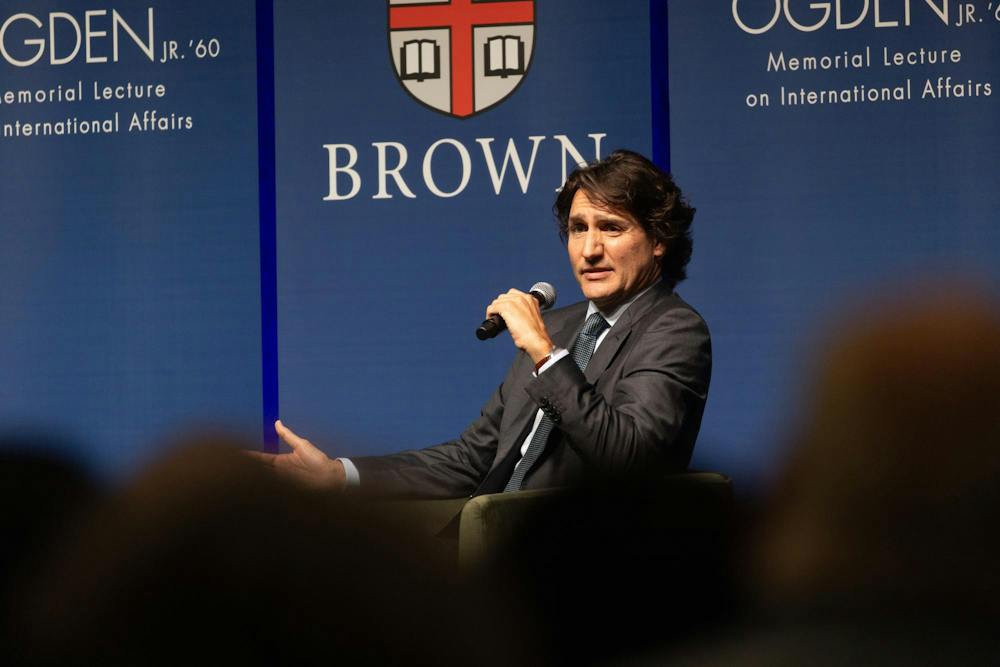
Justin Trudeau — Canada’s former prime minister, serving from 2015 to 2025 — recalled his time leading the country as swamped in briefing books and memos during a Tuesday lecture at Brown. Even so, he says he was reading a novel a week, because “staying connected with stories is how we shape things for the better.”
Trudeau shared stories of his own from his time as prime minister during the University’s 106th Stephen A. Ogden Memorial Lecture on International Affairs, which was titled “Leadership, Democracy and the Evolving Global Landscape” and centered around navigating regulation, diplomacy and diversity in the newly fragmented global order.
“It’s a time of extraordinarily significant upheaval in the world,” Trudeau said in his initial remarks. “The rules-based order that has held us through about 80 years is faltering.”
But now that “fairly solid international rulebook” is falling apart, and “there really is no clear sense of where we’re going to end up,” Trudeau said. He implored today’s young adults to “be as active as possible in helping shape” the future of the world.
Following Trudeau’s opening remarks, President Christina Paxson P’19 P’MD’20 interviewed the former prime minister, addressing questions submitted by students and faculty.
After reflecting upon the lessons he learned as prime minister, Trudeau zoomed in on his experience navigating trade relations with the United States. Trudeau recalled President Trump taking office in his first term and vowing to “tear up NAFTA, the North American Free Trade Agreement, the most successful trade agreement in history,” he said. But Trudeau, confident that “more trade creates more wealth,” led Canada through a tumultuous and ultimately successful renegotiation of the regional trade agreement.
Trudeau said that his “ability to stand strong in your principles and look for the win-win … is the difference between negotiating between countries and … making a real estate deal.” He added that “when two countries work well together, as Canada and the U.S. always have, you come out positively and both can grow and both can be happy.”
Paxson’s follow-up question asked for Trudeau’s outlook on “trade tensions” between Canada and the United States that are now unfolding years after the prime minister’s renegotiation of NAFTA.
“I love that you use the frame ‘trade tensions,’” Trudeau said. “Nobody in Canada thinks of them as trade tensions.” He said that Canada and the United States have previously had trade disputes over issues like fishing and lumber, but “this is more than that…because this is not about improving things for the U.S. citizens or workers.”
“There is a pattern here of doing things that are driving up prices for (American) consumers,” Trudeau said, using the example of U.S. tariffs on aluminum, which have increased the cost of beer in the United States. “The unpredictability is the U.S. administration is no longer working in the best interest of the American people.”
As the conversation pivoted to healthcare policy, Trudeau once again highlighted U.S. shortcomings.
In response to a question from Paxson about the shortcomings of Canada’s healthcare system, Trudeau conceded that the country’s system “has a challenge with rationing and wait times,” but bit back with a question of his own, asking, “How does someone who doesn’t have healthcare coverage in the United States feel about wait times or rationing?” Trudeau was met with a rousing applause from the audience.
“The U.S. spends more on healthcare than just about any other country per capita, and has significantly worse health outcomes for its population than most other countries,” Trudeau said, mentioning that Canada’s average life expectancy currently sits years higher than that of the United States. “Nobody’s going to become a billionaire through healthcare in Canada.”
Trudeau also addressed the growing challenges posed by social media and artificial intelligence, and the role that governments should play in regulating these technologies.
“Governments are spectacularly ill-placed to regulate emerging technology,” Trudeau said. But “the companies that have created these technologies…are not accepting the responsibility that comes with having technology that has foundationally altered the way citizens live their lives.”
Therefore, the responsibility to address the harms of social media falls onto the state, Trudeau said: “Governments shouldn’t have to, but we do have to.”
The rapid expansion of AI also poses a challenge, Trudeau said. “AI has moved so fast that the letter of the law was unable to keep up,” he said, and the world is now careening into the “unknown.”
“AI… is going to make as big a difference to humanity as electricity did,” he said. While it has the potential to improve lives, “it looks like it’s just in the business of creating a few more trillionaires.”
“It was interesting that he did call out things about the U.S. that are problematic…in a very resonant and a very real way,” Amelia Madrigal ’30 said. “I’m really glad that I went and that Brown gave us the opportunity to come sit here.”
Jillian Costello GS attended the talk for her class, CSCI 2999A: “Cybersecurity management within business, government and non-profit organizations.” “I really appreciated his perspective on social media,” she said, adding that “I’m really glad he…said that companies need to take responsibility for their role in technology.”
“I think it’s important to hear from the Canadian perspective because…we’re in an American bubble,” she said, adding that the trade-related segment of Trudeau’s talk “really opened (her) perspective.”
Iris Luo ’29, who serves as financial minister for the Canadian Students Association at Brown, said she came to the talk because “being Canadian is a really strong part of (her) identity.”
“He’s a very compelling speaker,” Luo said, adding that she appreciated that Trudeau’s talk was “a good representation of how Canadians feel…amid these trade tensions.” He reflected “our current struggles really well,” Luo said.
Despite the unprecedented challenges facing today’s world, Trudeau’s talk ended on an optimistic note. He celebrated the Canadian “mosaic” of people with different cultures and backgrounds, united by a shared set of values. While diversity is often “exploited as a weakness,” Trudeau hailed it as a strength that produces stronger solutions to complex issues.
Addressing the Brown students in the audience, Trudeau said that “if you can come at the challenges of this world…from a place of curiosity, intellectual honesty, openness, critical thinking, grace and compassion, then I think we’ll be alright.”

Pavani Durbhakula is a Metro editor. She is a junior from DC and is studying IAPA and Public Health. In her free time, she enjoys baking, reading and searching for new coffee shops.


