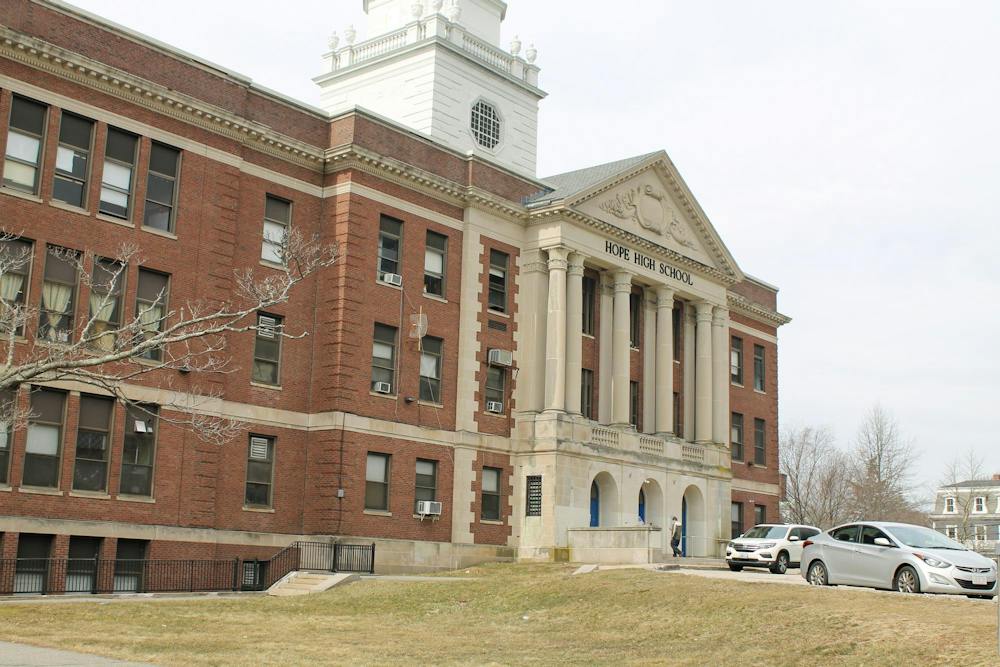
Rhode Island has not been known for top-performing high schools in the past. But in this year’s U.S. News Best High Schools list, the state ranked eighth in the nation, Gov. Dan McKee and Education Commissioner Angélica Infante-Green announced on Aug. 19.
According to Rhode Island education officials, this ranking is based on changes in graduation requirements, a shift in post-secondary education preparation and both state and local education initiatives to improve student attendance.
“The state really took a deep dive into the high school experience to see what the significance of a high school diploma or the experiences that came with a high school diploma really were,” said Victor Morente, the chief of external affairs at the Rhode Island Department of Education. He explained that RIDE found a discrepancy in student programming across the state.
Eighty percent of kids across Rhode Island wanted to go to college, according to Steve Osborn, student opportunity officer at RIDE. But only 60% of students took the classes necessary to be eligible to go to most regional four-year colleges, such as the University of Rhode Island and Rhode Island College, Osborn said.
“When we took a step deeper, we saw that only half of our kids actually had passed those classes,” Osborn said. “That led us down the path of adopting readiness-based graduation requirements.”
Policies like the Readiness-Based Graduation Requirements were implemented with the class of 2028. Since implementation, students in Rhode Island have done better on Advanced Placement test outcomes and SAT scores, according to Osborn.
Osborn said this was partially due to RIDE’s investment in professional development and test fee waivers for students enrolled in AP classes.
As of March 2026, Rhode Island has finished first nationally among states in 10-year growth of qualifying AP scores. Michael Hobin, director of college and career readiness at RIDE, added that Rhode Island achieved its highest graduation rate during the 2025-26 academic year at 85.5%.
“All students have access to these advanced courses, and so we’ve seen a pretty significant increase in the number of students taking and passing AP tests from traditional and traditionally underserved demographic areas,” Hobin said.
There has also been a push to tackle chronic absenteeism. Students who are chronically absent consistently underperform compared to students who are not, Morente said.
“Kids need to be in front of the teacher at all times. If the student’s not at school, they’re not learning what the teacher’s teaching,” Hobin said.
“We’ve reduced chronic absenteeism since its height by 14 percentage points, so that equates to about 4.4 million hours of instructional time recovered for our students,” Morente said. Rhode Island had the fifth largest decrease nationally in chronic absenteeism from 2024-25, he added.
The Providence Public School District “has led the state in reducing chronic absenteeism,” PPSD spokesperson Alex Torres-Perez wrote in a statement to The Herald. Absenteeism reached a record-low rate of 25.3% last school year, Torres-Perez added.
Torres-Perez added that, “for the first time, every PPSD high school offers a (career and technical education) pathway.” CTE pathways provide opportunities for students to take classes on specific jobs or industries.
Classical High School, consistently ranked as the top high school in Rhode Island, has not been exempt from the challenge of chronic absenteeism. In an interview with The Herald, Classical High School Principal Scott Barr emphasized the importance of mitigating class absences.
“I think students felt an increased appreciation of the school post-COVID,” Barr said. “I think they enjoyed being together, participating in sports and that sense of community.”
Nate Barkow is a senior staff writer for the Youth and Education beat and a co-chief of The Herald's social media team. He is from New York City and plans on concentrating in International and Public Affairs and Education Studies. In his free time, he loves trying new restaurants and watching Survivor.