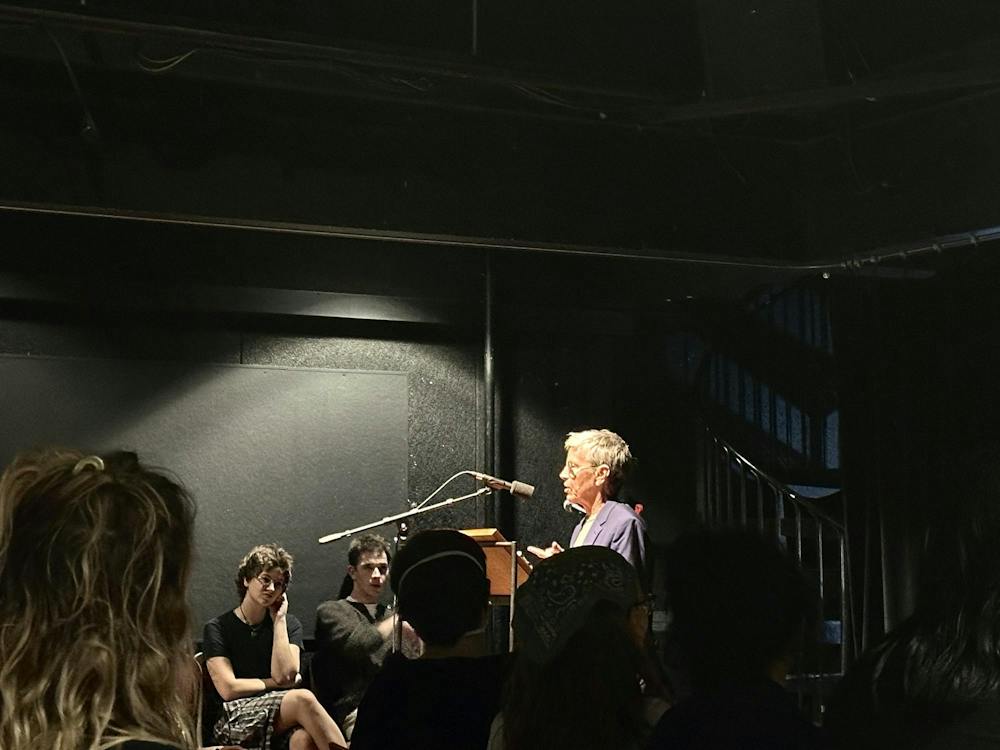
Last Thursday, Eileen Myles — a poet, novelist and art journalist — reflected on the meaning of poetry, morality and purpose during their visit to Brown.
Hosted by the Department of Literary Arts, the conversation was part of the “Writers on Writing” event series built into two courses: LITR 1200: “Writers on Writing” and the first-year seminar LITR 0710: “Writers on Writing Seminar.”
During the event, Myles shared samples of writing from a variety of their works, ranging from excerpts from an upcoming novel to a 79-page poem they wrote in 1978. The author also shared excerpts from their 2017 memoir “Afterglow,” a work students were required to read in both courses.
Among many honors, Myles is the recipient of a Guggenheim Fellowship, four Lambda Literary Awards, an Andy Warhol Foundation Arts Writers Grant and a Clark Prize for Excellence in Arts Writing.
The event began with an introduction by Erin Reese Alexander GS, a master’s student in the Department of Literary Arts. Alexander spoke to Myles’s witty style and raw candor, describing the writer’s range of subject matter as focused on things as “tiny as a little dog frightened by lightning, barking on a Parisian street” to “as large as an infinitely expanding daytime talk show set populated by hand puppets.”
The first poem that Myles read was called “Theater,” a title the author said they will likely use for their next book of poems. In the poem, Myles reflects on their career as a poet, writing “the embodiment of the poet is the point, and that’s why it’s okay for you to pay my parking ticket.”
Toward the end of the piece, Myles concludes, “survival is my art — a violent act it is.”
Later, Myles reflected on their broad goals as a writer. “I wanted being a poet to be a big job,” Myles said, “and so I decided to do things at that scale, and so then the world was obedient in a certain way.”
Myles also hopes that their work will effect change and address political unrest. They recalled how they initially had difficulty determining how to write poems about Gaza, and that the idea for one of their newer pieces on this topic came to them after one of their packages — an “expensive red kettle” — was stolen in their apartment building.
In the poem, Myles writes about how they “don’t know where to put” the “ordinary sadness” they felt about the kettle in relation to their feelings about the Isreal-Hamas war.
“If I had a whistling pot, I wouldn’t forget the water is boiling,” Myles writes in the poem. “I wouldn’t burn everything, would I? Must everything burn? If Gaza burns, must everything burn? Don’t they know?”
Myles also discussed their writing process in the question-and-answer section of the event. “I think that you are collecting stuff all your life,” they said, “then, when you think of some funny way to put it together, it just unleashes.”
In an interview with The Herald after the event, RISD senior Guthrie Siwinski reflected on Myles’s approach to writing poetry. “I really like that idea that you spend your life collecting, and then it’s mining that collection for whatever needs to come out,” he said.
“That’s exactly how I think about making work too,” he said.
Sonnet Phelps GS, a second-year Ph.D. student in comparative literature, was specifically taken by Myles’s epic poem “Bird Watching,” which the author wrote in 1978 at the age of 28. As a 28-year old herself, Phelps said they “got really excited about that.” Since hearing the poem, she said that one line has been stuck in her head: “My new natural philosophy is all or nothing.”
Throughout the event, Myles not only shared their work, but reflected on the meaning of poetry, morality and purpose. When asked how their purpose has changed as they’ve gotten older, Myles responded, “one has to slow down to keep writing.”
“Like long relationships, you have to keep making sh*t up to keep going,” they said.