If there is anything most Americans can agree on, it’s our nation’s natural landscape and, of course, dogs. Starring Brad Pitt, Paramount Pictures’s wilderness epic “Heart of the Beast” gives audiences a big taste of both, but without outstanding results.
David Ayer, known for writing “Training Day” and directing the 2016 “Suicide Squad,” had an estimated $82 million budget for the film. After hitting theaters on Sept. 25, the movie grossed $51 million in domestic and international box offices on its opening weekend.
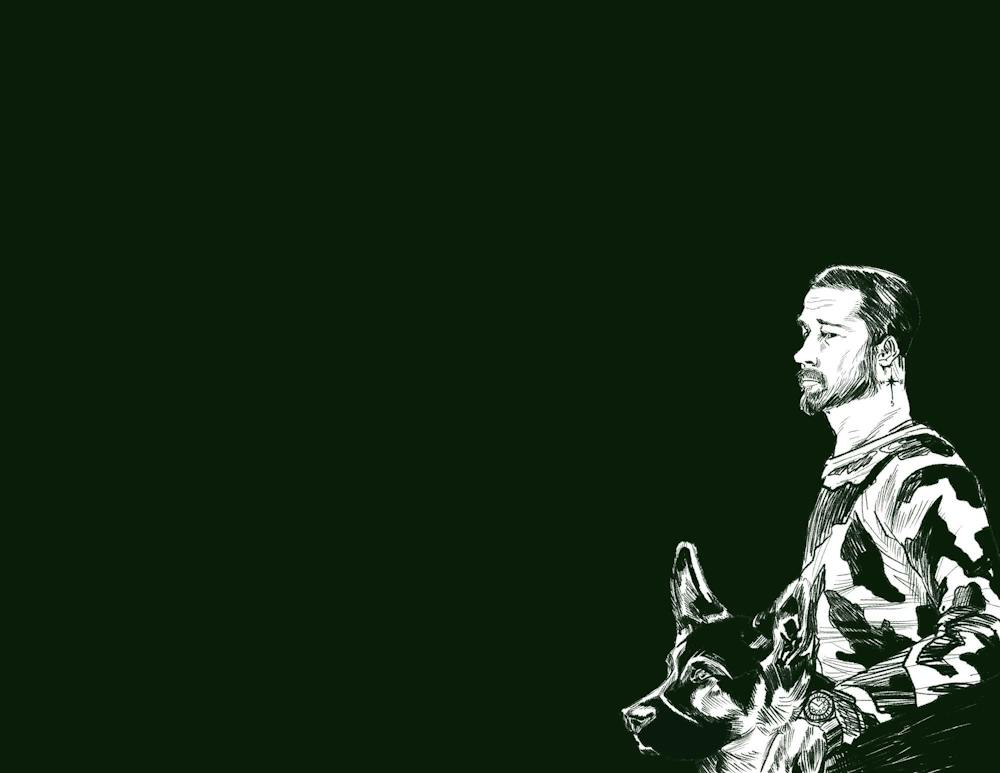
“Heart of the Beast” follows ex-commando James Belmont (Brad Pitt) and his German shepherd, Odin, who is traumatized by his experiences in war, particularly in Iraq and Afghanistan. The movie tracks the charming duo’s harrowing journey through unrelenting dangers after a plane crash into the Alaskan wilderness.
Featuring only three human actors, the film is remarkably sparse in its dialogue and instead speaks through its silence and visual portrait of a stunning Alaskan landscape.
But despite visual ambitions, “Heart of the Beast” lacks the action or narrative flow necessary to justify the duo’s 101-minute journey.
In the film’s pre-release marketing and in its opening sequence, “Heart of the Beast” is eager to make one fact very clear to audiences: The dog does not die. Whether this assurance for audience members averse to on-screen dog deaths was the original intention of screenwriter Cameron Alexander, Odin’s cemented fate removes any serious stakes from the narrative. Although Odin is sucked out of a crashing plane and attacked by wolves, the drama is dampened by the assurance of the dog’s survival.
This suspense-killer is only one part of the movie’s narrative struggle. Early in the film, Belmont lounges in his tent and reads passages from “The Road,” author Cormac McCarthy’s sparse and unsettling account of a father-son trek through postapocalyptic America. As the film attempts to embody “The Road” with silent emphasis on the importance of relationships in times of adversity, it stumbles over itself with predictable beats and poor pacing.
Pitt’s portrayal of the rugged and thoughtful James Belmont demonstrates acting abilities well within his performance wheelhouse of the stoic renaissance man. While James’s steadfast commitment to his canine companion is well represented by Pitt, the slimness of the dialogue prevents a notable acting performance from emerging.
The array of clichés combined with J.K. Simmons’s brief but unconvincing portrayal of a rural goldminer stereotype leaves the movie’s emotional core hollow and unengaging. Not only is there a lack of depth, but the uncomfortably long and silent sequences of changing clothes, pitching tents and other simple activities are rather boring.
Although Alaska’s vast natural beauty lends itself to on-camera glory, the film’s repetitive landscape montages fail to take full advantage of the visual space, with uninspired framing and scope. This leaves the film more accurately resembling a nature documentary rather than a movie interested in telling a story through its visual aesthetic. After all, with only one dialogue interaction in the whole movie, audiences should get to experience a visual style more unique than a video game cutscene or an Alaska tourism advertisement.
As an action-packed journey through an untamed northern wilderness, “Heart of the Beast” is enjoyable. But because of a predictable, uninteresting narrative and a photographic direction that does not take full advantage of the landscape, the creators fail to make audiences connect with James and Odin.