Netflix’s new release “Unabomber” opens with Thomas Mosser unwrapping a mysterious package in his 1994 suburban living room. The scene immediately devolves into drama as the package explodes. Mosser was one of the three individuals killed by Ted Kaczynski, who was responsible for the injury of 23 more. Director Janus Metz attempts to explain Kaczynski’s evolution in hopes of answering what turns a person into the Unabomber.
But for all its ambition, the film falls short, providing an answer that felt too simple and concrete for the grave reality of its subject matter.
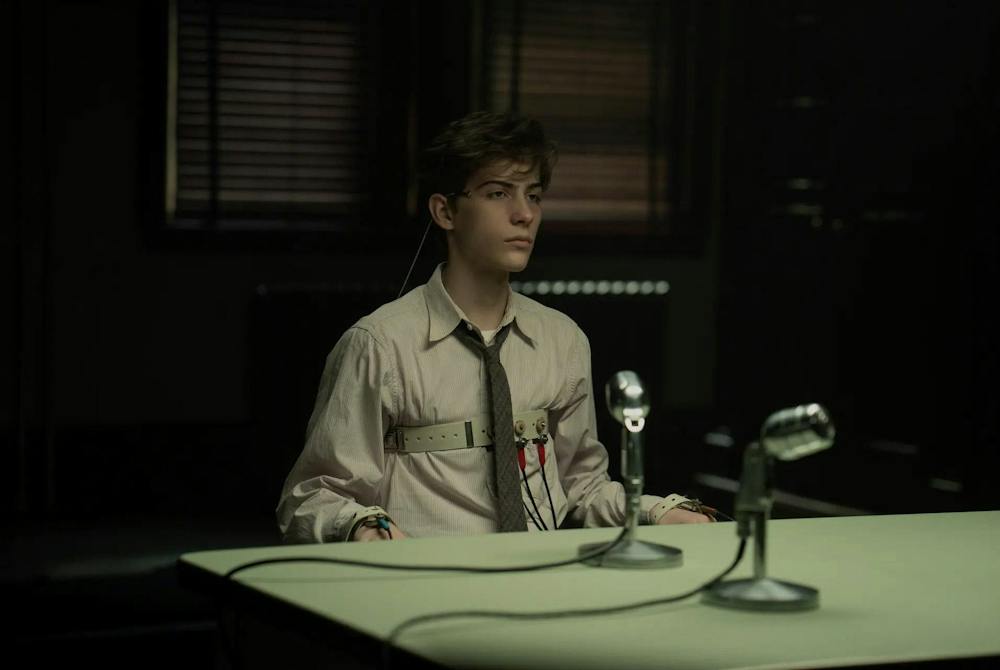
The film has a promising setup: “Unabomber” is structured along two distinct timelines. The first follows a young prodigious Kaczynski (Jacob Tremblay) after he started at Harvard on a full scholarship at 16 years old. Although he is remarkably intelligent, Kaczynski struggles to adjust to the new environment, leading to his quiet isolation. He becomes involved in a series of psychological experiments conducted by Harvard professor Henry Murray (Russell Crowe), where he becomes subject to a world of psychological distress.
Crowe’s performance as Murray is especially unsettling because the professor does not appear inherently cruel. Instead, his actions seem to emerge from a desperation for his research to be seen as important. This makes the relationship between Murray and Kaczynski one of the more interesting parts of the film, particularly as Kaczynski becomes increasingly affected by the experiments.
The film finds further strength in Tremblay’s portrayal of a young Kaczynski. His stiff conversations and anxiety around other students make Kaczynski’s loneliness feel genuine, offering a more complex portrait of his descent into madness than the oversimplified explanations that the film later offers.
The second timeline takes place years later, as FBI investigator Joanne Miller (Shailene Woodley) attempts to uncover the Unabomber’s identity. With only scraps of evidence about the man behind the attacks, Miller and her team search for patterns across decades of explosives, victims and writings.
Although the film presents a unique structure — moving between Miller’s pursuit of Kaczynski and the younger man he once was — it poorly attempts to reconcile the person behind the attacks with the experiences that preceded his crimes. Kaczynski’s animosity toward the world is portrayed as originating from his experience at Harvard alone and what began as a complicated portrayal of an isolated teenager becomes a much cleaner story of an experiment that went too far.
The film spends considerably less time confronting the choices Kaczynski made following his college graduation. By not examining his life beyond Harvard, the film makes it seem as if the circumstances surrounding Kaczynski were more responsible for his violence than Kaczynski himself.
In reality, Kaczynski’s path from Harvard student to Unabomber was far less direct. After entering Harvard, he earned a doctorate in mathematics at the University of Michigan. Kaczynski went on to become an assistant professor at the University of California, Berkeley at age 25. He abandoned academia in 1969 and moved to a small, secluded cabin near Lincoln, Montana. His first bomb appeared in 1978, many years after his time at Harvard. Over the course of his 17-year-long bombing campaign, every targeted individual was connected to modern technology — a detail that is woefully underrepresented.
“Unabomber” is meant to be inspired by true events. If the film was entirely fictional, many of the additions and exaggerations of the real story could make for a fun watch. But a true crime film does not have the same freedom as fiction, especially when these changes try to provide explanations for why a real person committed real acts of violence.
The film is disinterested in explaining how authorities actually discovered Kaczynski. After spending much of the film emphasizing the difficulty of the investigation, his identity is uncovered relatively quickly. In the end, his capture reflects the rest of the film — unsophisticated and criminally oversimplified.
Timothy Ro is a senior staff writer covering arts and culture.