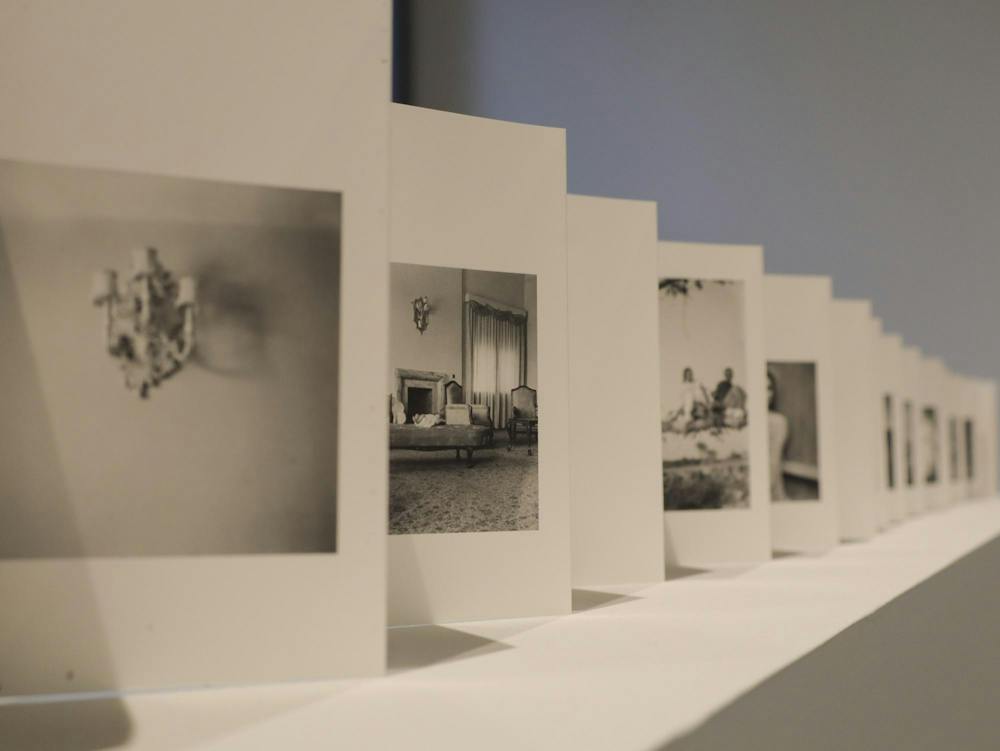
Upon entering the Brown Arts Institute’s latest exhibition in the Granoff Center for Performing Arts, visitors are met with an interactive pamphlet that deviates from the typical flyer: a foldable zine that acts as the gallery’s catalogue.
On Oct. 1, the Department of History of Art and Architecture came together with the BAI to co-host the opening reception for “Building Books with Dayanita Singh,” which was curated by students in the fall 2025 course HIAA 2930: “Museum of Possibilities.” Centered around the New Delhi-based artist Dayanita Singh, the practicum allowed students to collaborate with Associate Professor of History of Art and Architecture Holly Shaffer on the long-term curation project.
The exhibition, which features pre-existing works from Singh, was organized by the course’s students throughout the semester. In addition to arranging the space, they also added a variety of interactive elements.
Before teaching the course, Shaffer and Singh met in New York and connected through their shared interest in South Asian architecture. The two developed the syllabus for HIAA 2930 together, Shaffer said.
“(Singh is) a brilliant photographer, portable photo museum maker and a bookmaker,” Shaffer said. “I’ve always admired her practice, but also her pedagogy.”
The project is based on Singh’s 2022 manifesto “Book Building,” which reimagines publication as a vehicle for transforming a space. The display stars an array of Singh’s pre-existing collections, including “Blue Book” (2009), “File Room” (2013), “Museum of Chance” (2014) and “Sent a Letter” (2008).
Benet Ge GS — a second-year Ph.D. student studying the history of art and architecture — praised “Blue Book” for its innovative display of scattered and torn postcards. He admires how Singh plays with modularity in the piece, creating “perforations” in a book with “no real set order” to how they are viewed, Ge said.
While the exhibition forefronts Singh’s work, it also contains multiple interactive stations created by the students in dialogue with the artist’s oeuvre. Virtual meetings with Singh throughout the course motivated students to place an emphasis on the literal space, light and architecture of the exhibition.
While planning the layout of the exhibition, “we thought about what it would mean to honor (Singh’s) vision,” said monaye johnson GS, a third-year Ph.D. student studying Africana studies. She added that Singh is “big on interacting with her work,” and that the class “wanted something interactive as well.”
One of the student’s additions to the space is a camera lucida — a device that invites visitors to pick up a pencil, peer through a pinhole camera and sketch the contours of reflecting light through the window. To further call attention to the physical space, the class added black strips of tape to the floor that run parallel to the overhead beams and lines in the ceiling.
Tristan Whalen GS — a second-year Ph.D. student studying the history of art and architecture — designed a bench featured at the front of the exhibition. Inspired by the minimalist work of Donald Judd, Whalen said he hoped the bench would “be in a tectonic conversation” with its accompanying table, inviting visitors to “engage with the work” and offering a “familiar idiom (from) a traditional gallery.”
“These kinds of collaborative processes are always a little bit of an experiment,” Whalen said. “It was truly a labor of 100 different impulses.”

Kendra Eastep is an illustration chief and a Senior Staff Writer for Arts & Culture. She is from New York City and concentrates in English and History. While she draws, she likes to drink peach tea and watch video essays.