
In the minutes preceding this year’s Opening Convocation, first-years — still taking in the wonders of College Hill — wandered the Main Green with new friends. A cacophony of bagpipes, bell-ringing and cheering permeated the air leading up to the main event. As the ceremony began, a quiet excitement imbued its proceedings.
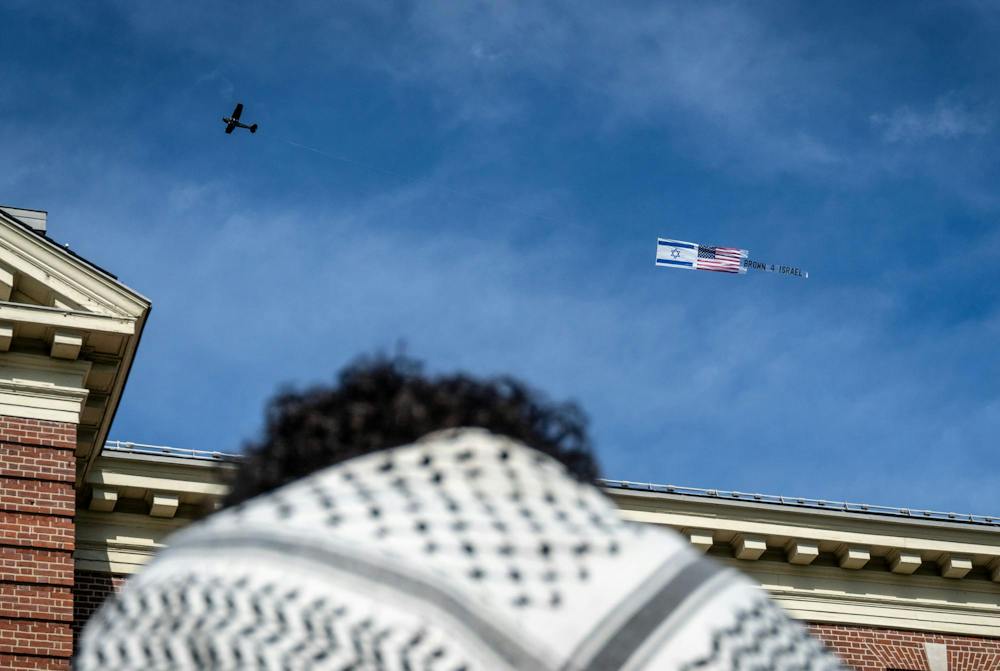
However, one thing stood out against the bright sky, discordant with the day’s light-hearted sentiment: a loud plane hauling an Israeli flag, an American flag and a banner reading “Brown 4 Israel.” The plane circled the Main Green throughout the entire ceremony. Last week, on Oct. 7, it flew above campus again.
Rhode Island Coalition for Israel organized the plane’s presence at convocation — and during at least three other Brown ceremonies — in order to show support for Jewish students in a moment of perceived threat. It has circled campus at least five times over the past two years, but has done little to sway individuals, according to student reactions documented by Herald reporting. I am not writing this column to proffer my views about Israel. I am writing to criticize a culture — national, and present at Brown — that communicates slogans from a distance. This practice is antithetical to the principles that should define constructive political discourse.
The plane offers no opportunity for engagement from students. Rather, by introducing contentious topics to apolitical events, it likely intensifies previously held animus and polarization on the issue. Such ideological proselytizing reinforces a culture of expressing beliefs without discourse. Without a major change, our campus may deviate further toward strongly expressed dogma and hyperpolarization. Instead, we should be pursuing nuanced ideological interchange.
While the funders of the plane are unaffiliated with Brown, such ideological proselytizing has also come from Brunonians, on social media and across campus bulletin boards. Chanted slogans and passionate political displays have often been chosen over rational dialogue. But — unlike most political hot topics — the Israel-Palestine conflict provides a rare opportunity for discourse because it is a topic upon which Brown’s student body is ideologically split. In an October 2024 poll conducted by The Herald, more than 60% of Brown undergraduates expressed support for a proposal to divest from companies affiliated with Israel. Pro-Israel sentiment is also present on campus, with an open letter in support of Israel receiving more than 980 signatures from alums and students.
Brown Students for Justice in Palestine and Brown Students for Israel are active student organizations, both of which organize programming throughout the year. Given this diversity of opinion, rhetoric surrounding this issue should not be uncompromising or unequivocal. Categorical statements — commentaries that are absolute and leave zero room for debate — should not have a place in political life, particularly not in a subject area in which there is an exigent need for discussion.
In a recent editorial about Brown’s meager placement in the Foundation for Individual Rights and Expression free speech ranking, the editorial page board argues, “If students want to stop their peers from self-censoring, they should take the time to understand their perspectives, open up conversations and listen.” I could not agree more. That is exactly why we should view the protest plane as a warning. Trumpeting messages without engaging in conversation is dangerous. It is how we become politically polarized and begin dehumanizing those with opposing views.
Campus tension over the Israel-Hamas war will not be resolved through a series of community discussions — this is clear. That said, we all need to do a better job of examining our political activity and discerning its true aim: Does it tangibly improve on-the-ground conditions, or does it, like the plane, reinforce an ideological bubble and stymie open conversation? This is a quandary every student should grapple with in their time at Brown. To sway one another on any range of issues, we should choose multidimensional, empathetic discussion over the imposition of ideological dogma.
Anya Kleinman ’30 can be reached at anya_kleinman@brown.edu. Please send responses to this column to letters@browndailyherald.com and other opinions to opinions@browndailyherald.com.
Clarification: This article has been updated to better reflect the Rhode Island Coalition for Israel’s involvement with the organization of the protest plane.


