
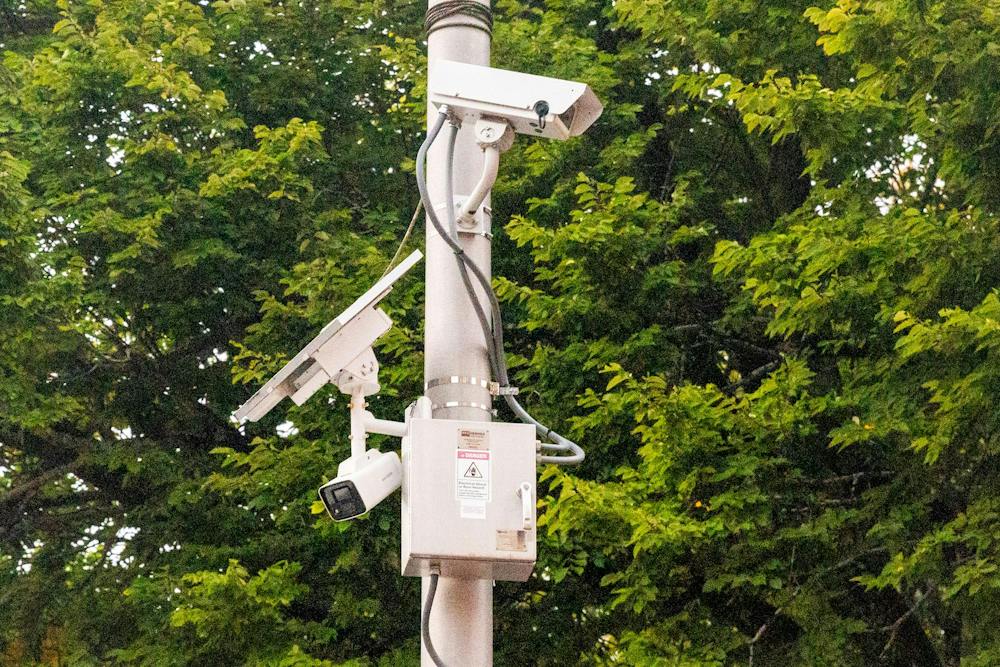
On Thursday, the Providence City Council referred an ordinance that would prohibit automated license plate readers in the city.
According to the text, the amendment aims to prohibit “automated license plate readers and similar technologies.” It cites constituents’ concerns “grounded in patterns of behavior in other jurisdictions,” including U.S. Immigration and Customs Enforcement using Flock data to “kidnap immigrant neighbors,” authorized users using Flock to stalk partners and misidentification of individuals.
User access to Flock data is controlled by role-based permissions and data sharing is not enabled by default. Recently, Flock cameras have sparked protests throughout the country about data privacy, with more than 100 cities discontinuing their use of the technology.
A report by students at Rhode Island College, first presented to the council in May, found more than 3.2 million searches of Providence’s Flock data were from cities not listed on Providence’s Flock Transparency portal between November 2024 and November 2025. More than 1,400 jurisdictions accessed Providence’s data.
If the ordinance is enacted, Providence’s 60 operating Flock ALPRs will be deactivated and the city will stop accepting services from Flock Safety. City employees would also be barred from accessing license plate reader data from any system, including ones the city doesn’t own.
These cameras record “every single passing vehicle continuously, including their location, the time they were seen, regardless of whether anyone is suspected of a crime,” said Ward 1 councilor John Goncalves ’13 MA’15 during the meeting.
In “a city that’s disproportionately Black and brown,” Goncalves added, surveillance systems like Flock can be used to further harm already-marginalized communities.
He said Flock’s additional capabilities, including drone and AI-powered technology, are “only expanding your surveillance network.”
Providence Chief of Police Oscar Perez was not consulted before the ordinance was introduced in the City Council, wrote Kristy dosReis, Providence chief public information officer, on behalf of Perez.
“There is a difference between writing legislation and understanding its operational consequences,” the statement read. “I would have welcomed the opportunity to provide input before language affecting police operations and criminal investigations was drafted.”
“Decisions of this magnitude should be informed by the professionals responsible for carrying them out,” the statement continued.
Goncalves said he trusts the Providence Police Department to “act professionally with this technology,” but argued that “the usefulness of this tool does not place a surveillance system beyond scrutiny.”
After review by the HOPE Committee, the ordinance will return to the full council, where it must pass two majority votes before going to the mayor, who can sign or veto the legislation.
Correction: A previous version of this article noted the ordinance will be referred to the wrong committee. The Herald regrets the error.


