
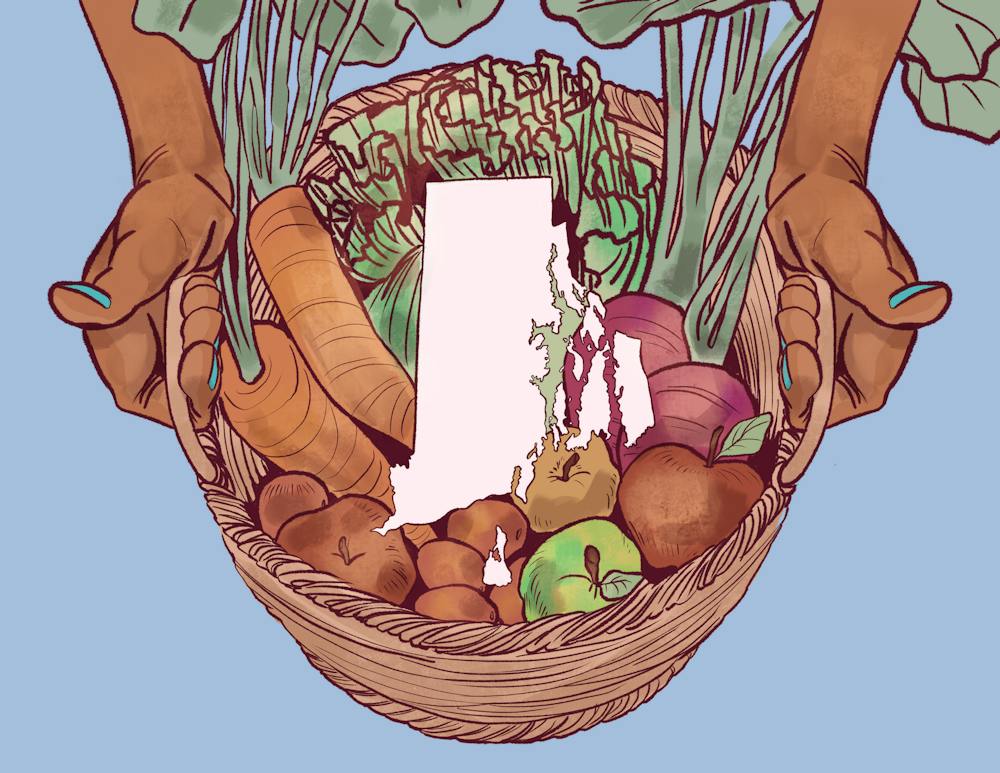
On Oct. 5, several of Rhode Island’s federal and state officials gathered at Farm Fresh R.I. in Providence to kick off the state’s second annual R.I. Grown Week. This year, the Department of Environmental Management celebrated almost $16 million in federal and state funding for farms and fisheries, disaster relief assistance and specialty crop producers.
Although there are more than 1,000 farms in Rhode Island, “only 2% of people (in the state) actually work in agriculture,” according to Ananda Fraser Ramirez, chief of RIDEM’s Division of Agriculture and Forest Environment.
R.I. Grown Week aims “to highlight and bring awareness to the farms in our state and the food they produce,” she added.
U.S. Sen. Sheldon Whitehouse (D-R.I.), State Rep. Michelle McGaw (D-Little Compton, Portsmouth, Tiverton) and State Sen. Susan Sosnowski (D-South Kingstown) made appearances at the kickoff event.
Ramirez emphasized the importance of Rhode Island’s political representatives’ support of “the work that we do in order to keep our farms viable.”
“People need local agriculture and locally grown products,” said Jay Gray, co-owner of Festival Farm in Hopkinton. “Everybody should be seeking it out.”
The first day of R.I. Grown Week also saw the opening of applications for the R.I. Disaster Relief Program, which dedicates around $15 million to disaster relief for farms impacted by weather events in 2023 and 2024.
According to Ramirez, the disaster relief program is the first of its kind in the state, providing reimbursements to eligible producers for up to 80% of approved losses. After the first round of applications, RIDEM will open up a second round barring capacity issues, she added.
“We want to make sure that (these funds) get into the hands of people who need them and who experienced those losses,” Ramirez shared. “Getting to where the farmers, fishers and foresters are is what’s going to be most important there.”
Ramirez said that another priority for RIDEM is the Specialty Crop Block Grant Program, which will allocate about $150,000 in grants to support the production of specialty crops — like those typically found at farmers markets — including fruits, vegetables, horticulture and floriculture.
According to the 2022 Census of Agriculture, nursery, greenhouse, floriculture and sod accounted for 55% of Rhode Island’s agriculture product sales. Vegetables and fruits made up an additional 20% of sales.
The third funding program included in the $16 million in funding is the $500,000 Local Agriculture and Seafood Act grant program, which opened applications on Oct. 15.
The impacts of initiatives celebrated by R.I. Grown Week will reach College Hill, according to Jed Cosgrove ’27, purchasing coordinator of the Brown Market Shares Program.
The organization runs a weekly market consisting of sustainable produce and other foods and “provides discounted shares to low-income faculty, staff and graduate students,” Cosgrove wrote in an email to The Herald.
“Our vegetables tend to come from a mix of both Rhode Island and nearby Massachusetts farms, and all are around an hour’s drive away,” he added. “This year’s (RIDEM) funding priorities emphasize regenerative agriculture and affordability, which are two of BMSP’s highest priorities as well.”
This year’s R.I. Grown Week also featured farm-to-school projects. In collaboration with Farm Fresh R.I., RIDEM worked to incorporate a local ingredient into every item on the menu at North Providence High School during one day of R.I. Grown Week, ranging from grains to cheeses to sweet potatoes, Ramirez said.
“We want to make sure … that students are having access to locally produced foods in their cafeterias,” she added.
Gray emphasized the importance of local agriculture in Rhode Island as a whole. “If you know where you buy from, you know what you get,” he said.
Annika Melwani is a metro senior staff writer covering state politics and justice. She is from New York City and plans on concentrating in English and International and Public Affairs. In her free time, she can be found reading or drinking an iced vanilla latte.


