
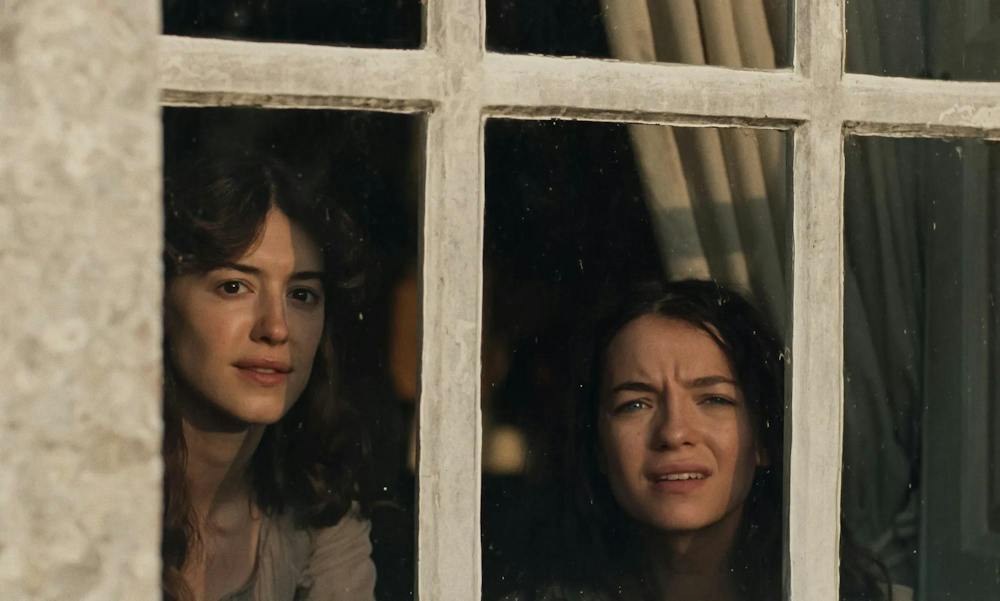
The only thing worse than a bad movie is a movie that is almost good, but just can’t seem to push itself across the finish line. Unfortunately, Georgia Oakley’s adaptation of Jane Austen’s “Sense and Sensibility” falls into this category — it is just short of memorable.
Watching the film is like going on a date with someone you really want to like. They’re so nice, they might even be cute, but you just don’t feel any connection. Oakley’s “Sense and Sensibility,” though deliciously scenic, is not evocative of the emotions that Austen excels at portraying in her novels.
Love stories require actors with a very specific skill set: being able to act big enough to portray the gravity of falling in love, and being able to act small enough to portray the intimacy of it. While Daisy Edgar-Jones, who plays Elinor Dashwood, is not a bad actor, she lacks the dramatic capabilities necessary to make audiences feel the deep longing, suffering and romance of Austen’s tale.
When Elinor sees Edward Ferrars (George MacKay) for the first time, the long stretch of silent staring suggests that this is meant to be a moment of love at first sight. Lamentably, Edgar-Jones’s face is so blank and unrevealing that audiences can only infer this supposed meet-cute from the camera direction.
Esmé Creed-Miles, who plays the second female lead, Marianne Dashwood, has a mesmerizing face, but her dialogue and delivery are subpar. She certainly brings the drama, with several instances of screaming and sobbing, but her performance — like Edgar-Jones’s — is played without nuance and fails to surprise or awe.
Worst of all is the entirely unconvincing delivery of dialogue by the two elder Dashwood sisters. While period piece dialogue can be difficult to pull off, the film’s failings cannot be blamed on the challenging nature of the genre — Chloé Zhao’s “Hamnet” and Greta Gerwig’s “Little Women” are two recent examples of stellar book-to-screen period piece adaptations. In both of those films, the dialogue feels natural and authentic, even though it differs greatly from the way we speak today. Though the dialogue in “Sense and Sensibility” becomes more bearable as the movie progresses, it continues to land as over-rehearsed and under-felt.
Edgar-Jones and Creed-Miles’s respectively stale and redundant performances are juxtaposed by hilarity from Fiona Shaw as Mrs. Jennings, who is by far the delight of the film. Bodhi Rae Breathnach is excellent and whimsical as Margaret Dashwood, but actors Caitríona Balfe as Mrs. Dashwood and Herbert Nordrum as Colonel Brandon are both disappointingly unremarkable.
Besides the dull acting, the greatest failure of this movie is its horrific pacing. The structure lets nothing simmer or build and jumps through time so unnaturally that character and relationship developments lose all of their weight.
“Sense and Sensibility” had the framework and potential to be a beautiful, moving rendition of Austen’s classic love story. The camera work, the sets and the production design are stunning — warm, nostalgic and sweet. With better casting and editing choices, the on-screen romantic and familial drama of Austen’s tale may have landed with the heart it carries in its text form.
Rebecca Goodman is an arts & culture and university news editor covering career and alumni. She is a senior from Cambridge, MA, studying English. Outside of writing, you can find her at the Avon or in the basement of the Rock.


