
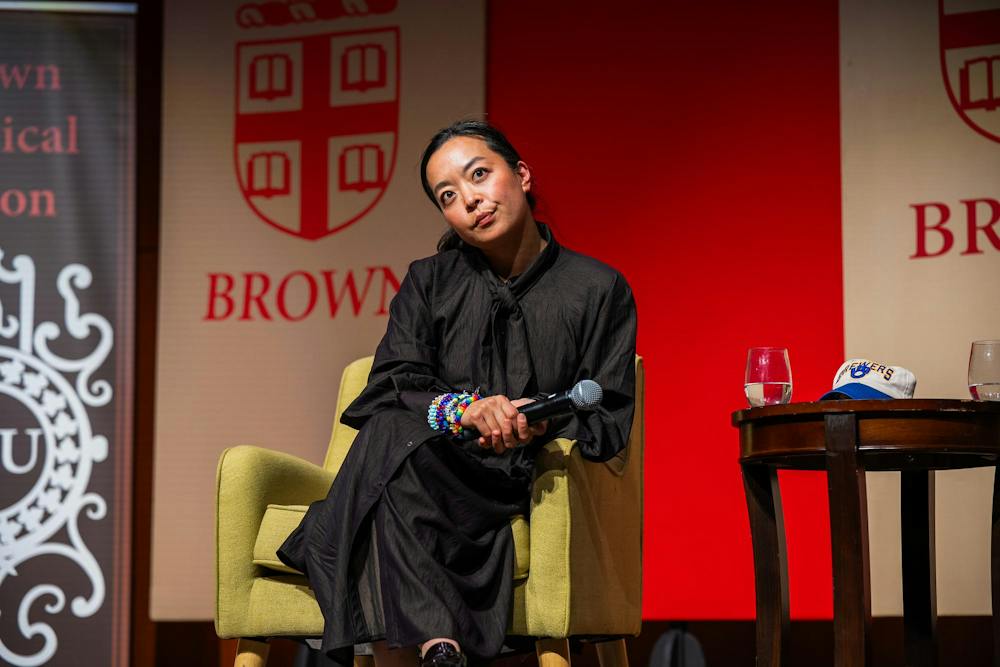
Last Wednesday, former gubernatorial candidate and Wisconsin State Rep. Francesca Hong (D-Madison) joined the Brown Political Union for a moderated discussion and Q&A session titled “Democratic Socialism and the Future of the Democratic Party.” Hong presented herself as a politician who is deeply connected with and accessible to the constituents she represents. That night, to model her acclaimed town halls, we were invited to ask Hong anything. “You went on Hasan Piker’s stream,” a student said after being called on. “He’s a very controversial figure, good and bad — I have more positive feelings — but I know a lot of (politicians) are going back and forth having to stand by him or denounce him. How do you deal with that as a politician and how do you think other politicians should deal with that?”
Rather than answering directly, Hong told the audience she would “talk to anyone and everyone.” The irony of Hong insisting she would “talk to anyone” while refusing to talk directly to a student is not lost on me. After turning down an opportunity for open dialogue with a student, Hong then branded the question “ridiculous” and lamented having to waste time denouncing or supporting a Twitch streamer instead of the countless issues that “people actually care about.” In minimizing the significance of her alignment with Piker, Hong avoided taking responsibility and failed to respond to valid student questions. Rather than sidestepping, those who speak at Brown should respect and respond to students’ questions.
Piker is a left-wing Twitch interviewer who successfully engages politically apathetic young men by weaving pop culture and humor into political news, and mobilizes grassroots campaign efforts. He is infamous for controversial comments which include claiming that the United States deserved 9/11, calling the United States worse than al-Qaeda, describing Orthodox Jews and Israelis as “psychopaths” and “inbred” and saying he doesn’t have an issue with Hezbollah.
Scoffing at questions regarding previous statements and alignments is a classic move from the populist playbook. So is labeling unflattering questions as not in the interest of working-class people. Anti-establishment populist politicians from former Louisian Governor and U.S. Sen. Huey Long and former Alabama Gov. George Wallace to Michigan Senator-elect Abdul El-Sayed and President Trump have been using deflection to reframe challenges as out-of-touch with “the people” or irrelevant to daily concerns. By labeling questions “ridiculous,” or casting them as not in the interest of normal people, Hong fails to live up to her proclamations of being a “different” kind of politician who cares for all her constituents' concerns.
When saying she’d “speak to anyone” Hong takes no accountability for the controversial people she’s aligned herself with. Politicians hold responsibility for shaping public discourse and by engaging with someone controversial, they normalize that person’s rhetoric. In the case of Piker, Hong’s willingness to appear on his show also contributes to driving traffic to the rest of his content. Hong’s interview with Piker garnered over 100,000 views on YouTube. Even though Hong’s appearance on the show brought extensive criticism, it also brought the streamer attention — which is what influencers thrive off of.
It is therefore important that politicians like Hong state in what ways they agree with those they associate with. They are responsible for making sure their appearance does not come off as an endorsement. Hong foolishly downplayed her ability to influence rhetoric. While Hong crowned the “lived experiences” of her constituents as her top concern throughout the event, she minimized the diversity of her voters priorities by deeming a valid question about her association with Piker as “irrelevant.” Hong seemingly has forgotten that politicians don’t get to decide what “the people” actually care about.
On College Hill, we too hold responsibility for shaping political rhetoric. Political discourse is formed by the continuous feedback loop between elected officials and their constituents, each adopting the other’s accepted rhetoric and policy. Historically, college campuses are a prime place for major social and political shifts — ideologies can be quickly transformed from the radical fringe to sensible mainstream. These changes can be positive but only if we approach new ideas critically. When listening to speakers, students have a responsibility to think critically, recognize the consequence of pithy political statements and actively push back against rhetoric they find problematic.
“Voters are becoming actually more sophisticated in sifting through the bullshit of certain political ads,” Hong said. Brown students must similarly become more sophisticated in sifting through political responses.
Lia Goldberger ’30 can be reached at lia_goldberger@brown.edu. Please send responses to this column to letters@browndailyherald.com and other opinions to opinions@browndailyherald.com


