
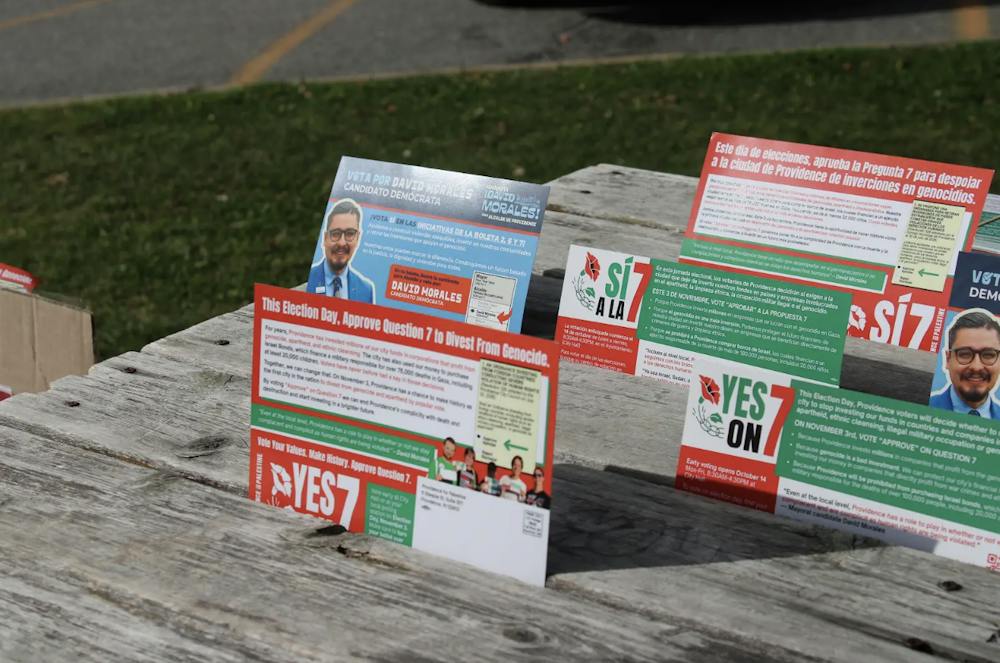
Providence voters approved Question 7, a proposed ordinance to divest funds from countries committing severe human rights violations, the Boston Globe and Rhode Island Current reported Tuesday night.
The ordinance requires the city to “refrain, to the best of its ability” from making future investments in these governments and “complicit” companies. It also obligates the City Treasurer to review city investments annually and publish a report on the city’s compliance.
The vote makes Providence one of the few U.S. cities to adopt divestment measures targeting governments accused of human rights violations such as genocide, apartheid, ethnic cleansing and prolonged military occupation. Other U.S. cities that have passed divestment measures include Medford, Massachusetts, Richmond, California and Belfast, Maine.
Providence is the first city in the United States to approve a divestment measure by popular vote.
The campaign for Question 7 was led by the Providence for Palestine coalition, which includes advocacy groups Reclaim Rhode Island, the Rhode Island Democratic Socialists of America, Jewish Voice for Peace Rhode Island and AFT Local 6516 — Brown Graduate Labor Organization’s parent union.
State Rep. David Morales MPA ’19 (D-Providence) — who was elected mayor of Providence on Tuesday — has expressed support for the ordinance. But both current mayor Brett Smiley and Republican mayoral candidate Dave Talan have publicly opposed it, citing concerns of antisemitism.
Some opponents have argued that the ordinance is directly targeting Israel. Providence for Palestine organizer Adit Sabnis GS previously told The Herald that while Israel “definitely” falls under the jurisdiction of the ordinance, other impacted governments and countries will be determined by “the process of enforcement.” Israel is not mentioned by name in the ordinance.
Nate Barkow is a senior staff writer for the Youth and Education beat and a co-chief of The Herald's social media team. He is from New York City and plans on concentrating in International and Public Affairs and Education Studies. In his free time, he loves trying new restaurants and watching Survivor.


