
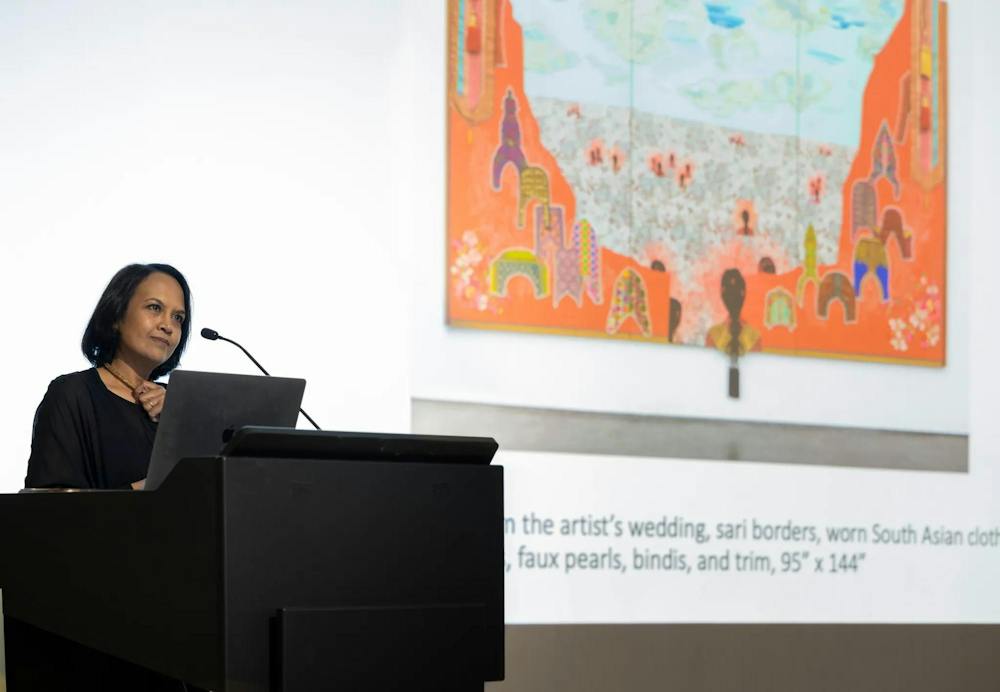
On Oct. 21, Suchitra Mattai, a Los Angeles-based multidisciplinary artist, spoke at the Department of Visual Arts’s first talk for the Visiting Artist Program of the 2026-27 academic year. In the lecture and a conversation with The Herald, she traced how her family’s history of indentured labor and her homecoming to Guyana shape her artistic practice, which works with saris, tapestries and inherited materials.
During the lecture, Mattai said that she underwent “a rebirth” of her practice about 10 years ago and began delving into the stories of her family and ancestors. She turned to the processes her grandmothers knew, such as sewing, embroidery and crochet, as well as materials like everyday clothing. “Fiber reflects a kind of vulnerability that I think is very tender and important in telling stories,” she said.
Her signature technique — which she described as a combination of needlepoint and embroidery — involves cutting worn saris into strips and knotting them through a rope net grid. “It’s almost like a dance,” she said.
Many of the saris come from India, and Mattai recalled opening the first boxes to the smells of perfumes and curries. The experience “was just very emotional,” she said. “I would actually start crying.” Her work aims to honor the women who previously wore the saris, she added.
Mattai has worked with other saris that came from local connections. When she knows whose garment she is working with, “that becomes part of the story,” Mattai said in an interview with The Herald. In larger works, the focus shifts from highlighting individual stories to “connecting diaspora over topography and through time.”
Born in Guyana, Mattai grew up in Nova Scotia and other locations across the East Coast. Her ancestors were among the Indians brought by British colonizers to work on Caribbean sugar plantations, she said in the lecture. Their “perilous voyages across the ocean for this supposedly better life … (are) something that I couldn’t even imagine,” she said.
During the talk, she showed images of works made using found European tapestries and needlepoints, which typically depict pastoral scenes of aristocratic leisure. She described integrating South Asian women into these images through embroidering and beading as “a kind of brown reclamation.”
Mattai said she is drawn to both breaking materials apart and searching for “a kind of wholeness” by fitting disparate pieces together. “Sometimes the connection can only come through fragmentation,” she said.
For a 2024 commission for Socrates Sculpture Park in Queens, New York, Mattai created six sari-wrapped structures, intended to serve as “a soft monument to women of the South Asian diaspora,” she said in the lecture. The work was inspired partly by glacial deposits she remembered from her childhood in Nova Scotia. Since the park sits on the East River, which feeds into the Atlantic Ocean, Mattai said that she wanted the work to evoke the ocean her ancestors crossed.
Her latest installation, “estuaries,” which is on display at the Fowler Museum at the University of California, Los Angeles, is named for the estuaries that feed into Guyana’s rivers and eventually oceans. The work features two portal-like doorways based on Hindu temple and palace architecture, which are meant to invite a “collective movement into a place of healing,” Mattai said.
“As an artist, you speak from the personal, but you want to speak to everyone,” she said in an interview with The Herald. She added that some of her career highlights have been when viewers — whether they are South Asian women like her or otherwise — tell her that a work made them cry: “That always touches me.”
She said that her recent trip to Guyana helped inform a solo exhibition she is opening in January, which will include a large-scale work with video developed from the visit.
For future works, Mattai said that she hopes to spend more time researching her family in colonial archives, building on the ideas around post-colonialism and subaltern studies that are embedded in her work.
When asked what advice she would give students from diasporic backgrounds who are beginning creative careers, Mattai stressed the importance of trusting oneself.
When she was a student, Mattai felt pressure to fit in and had little room to explore her diasporic identity. “You should never have to apologize” for “trusting yourself and exploring who you are,” she said.


