
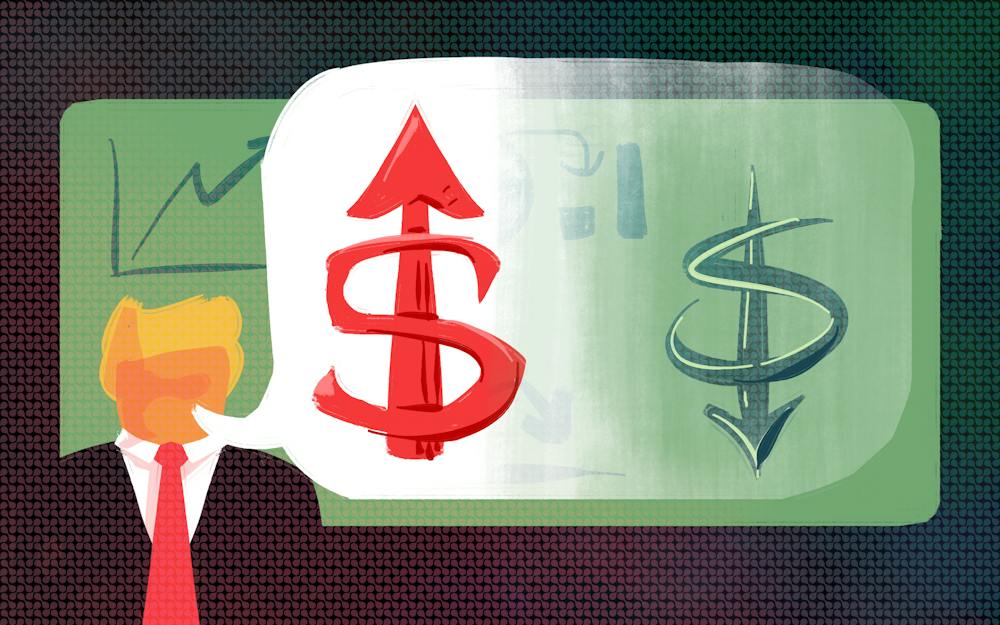
A new database from Brown’s Global Linkages Lab records every tariff rate President Donald Trump has “threatened, announced or implemented” since taking office. The database — titled Tariff Rates in Announcements, Declarations and Events — tracks tariffs that were announced in speeches, social media posts, executive orders or White House Statements, among other sources.
Although most of the tariffs never took effect, researchers say that the markets reacted anyway.
“Financial markets don’t like uncertainty,” said Sebnem Kalemli-Ozcan ’00, the lab’s founding director and professor of economics and international economics.
To create TiRADE, Kalemli-Ozcan worked alongside Can Soylu GS and Muhammed Yildirim, director of academic research at the Harvard Growth Lab. The current version of the database — which includes around 770 statements since Jan. 21, 2025 — has many data points timed to the minute. Data is updated every Monday.
The researchers created TiRADE to see if tariff announcements were driving the value of the U.S. dollar down, according to Yildirim.
The data introduced a new answer to why the U.S. dollar depreciated. “We quickly realized it wasn’t the level of the tariffs; it was the uncertainty associated with tariffs,” Yildirim said. “When there is uncertainty, investors get nervous.”
As a result, investors want to hold fewer dollars, causing the U.S. dollar to depreciate.
Tariffs generally strengthen the U.S. dollar in standard economic theories, Soylu said. Tariffs make imports more expensive, so Americans buy fewer foreign goods, making the exchange rate more valuable.
“Surprisingly, the U.S. dollar depreciated around tariff announcements,” Soylu added.
The current Trump administration has been unique, Kalemli-Ozcan said, noting that previously, “this uncertainty or this confusion” about the tariff rate did not exist.
The White House did not immediately respond to The Herald’s request for comment.
“The database grew out of a need to document everything about tariff announcements with a specific timestamp,” Soylu said.
According to Kalemli-Ozcan, around 30 percent of the database comes from executive orders, while the remaining data consists of other material, including campaign speeches and remarks made by the president over dinner.
TiRADE is free to use with attribution, and the team hopes other researchers will build on it to conduct their own research, according to Soylu. “What I would love to see is people exploring different questions,” Soylu said.
This exchange of information is already happening, Kalemli-Ozcan noted. She has received emails from a Harvard Ph.D. student and a University of Wisconsin-Madison undergraduate who used the data for their own research.
Having research on these policies will be important in the future as new administrations will likely evaluate these tariffs, Soylu said. With more data, researchers can continue “shedding light on things that then inform better decisions,” he added.
“Hopefully, in some small ways, it makes peoples’ lives better,” he said.
Elizabeth Rosenbaum is a senior staff writer covering science and research.


