
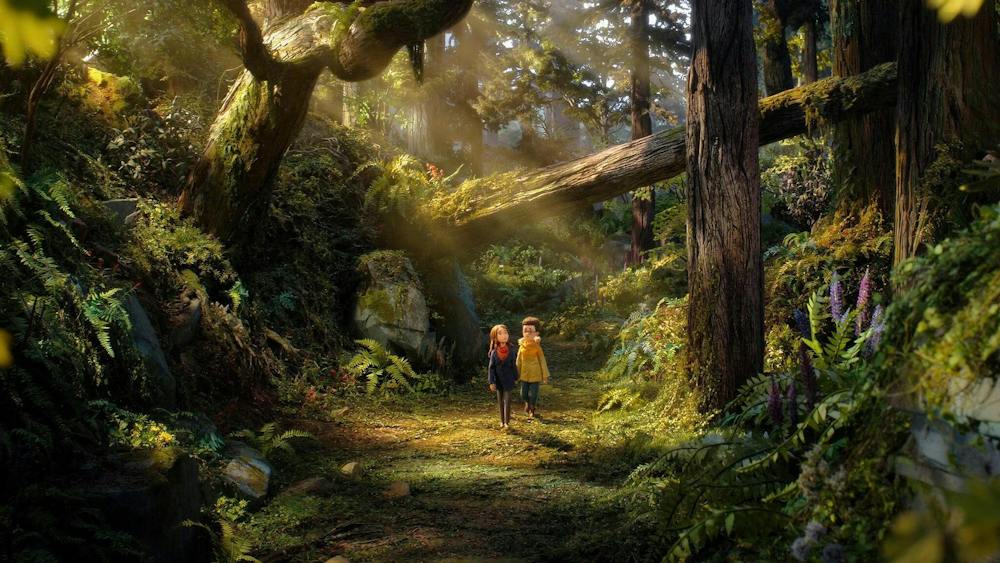
After 16 years of development, the studio behind “Coraline,” LAIKA Studios, released its sixth feature film, “Wildwood,” on Oct. 23. With a runtime of around 130 minutes, the film claims the title of longest stop-motion feature ever created.
The adaptation, based on Colin Melroy’s book of the same name, touches on themes of family, love and sacrifice, and has been described as a “masterpiece” by critics.
Set in Portland, Oregon, the film follows the story of Prue McKeel (Peyton Elizabeth Lee) who takes her baby brother Mac (Arthur Knight) out of the house, despite mysterious instructions from her parents not to leave home.
Prue’s story — both in the magic of its plot as well as the medium through which it’s conveyed — is an ode to the human forms of art that can still thrive in a world dominated by artificial intelligence.
What starts as an innocent tale of sibling bonding quickly turns into something much darker. When Mac is taken by a murder of crows into the enchanted woods on the outskirts of the city, Prue and her awkward classmate Curtis (Jacob Tremblay) drop everything to save him.
Throughout their journey, the pair encounters a host of strange creatures — including talking coyotes, giant birds and a helpful rat — as well as various systems of power that test their ability to discern friend from foe. On multiple occasions, the audience struggles to figure out who is on the protagonists’ side. Apparently good characters betray one another, while characters who seem undeserving of trust end up becoming the backbone of Prue’s tenacious fight.
The writing of Prue’s character is rich and unique. She acts far more adult than she actually is — audiences’ introduction to the teenager is her refuting her father’s stories of magic while drinking a shot of espresso. In an interview with NPR, director Travis Knight commented that he sees Prue as “an honest portrayal of a Portland kid” who is crossing the threshold from childhood to adulthood.
Prue’s experiences in the forest force her to be responsible for issues far above her maturity level, but she relentlessly rises to the challenge and proves to her parents.
The stop-motion style of “Wildwood” only enhances its monumental narrative. The crew’s years of meticulous designing, sculpting, 3D-printing, mechanising and sewing before finally filming the puppets pay off magically throughout the film — most notably through Prue’s over 140,000 constructed facial expressions.
The sheer volume of time, work and artistic attention that went into the film’s creation “is antithetical to all the technological advances that we’ve seen in our modern society,” Knight said in his NPR interview.
Though all of LAIKA’s previous features were rated as PG, “Wildwood” is the studio’s first PG-13 film, likely due to the dark storyline involving the Dowager Governess Alexandra (Carey Mulligan) and a staggering, violent 12-minute battle sequence towards the story’s end.
Knight told NPR that while he was “not surprised when they deemed this film a PG-13 film,” he emphasized that the film should still be viewed by kids, adding that “a lot of modern cinema tends to sanitize these things.” Like Prue, “young people have complex inner lives, just like we do,” Knight said.
“Wildwood” — just like Mac, Prue and Curtis’s experience in the “Impassable Wilderness” — swallows you whole. Immersed in the stomach of LAIKA’s work, viewers gain a true appreciation for the labor of love that is art.
Millie Barter is a senior staff writer covering RISD.


